


Only 4% of businesses are using ChatGPT Ads today
ChatGPT Ads opened to self-serve advertisers in May 2026. Six months on, we looked at how many businesses are using them and how that compares with Google, Meta and Microsoft ads.
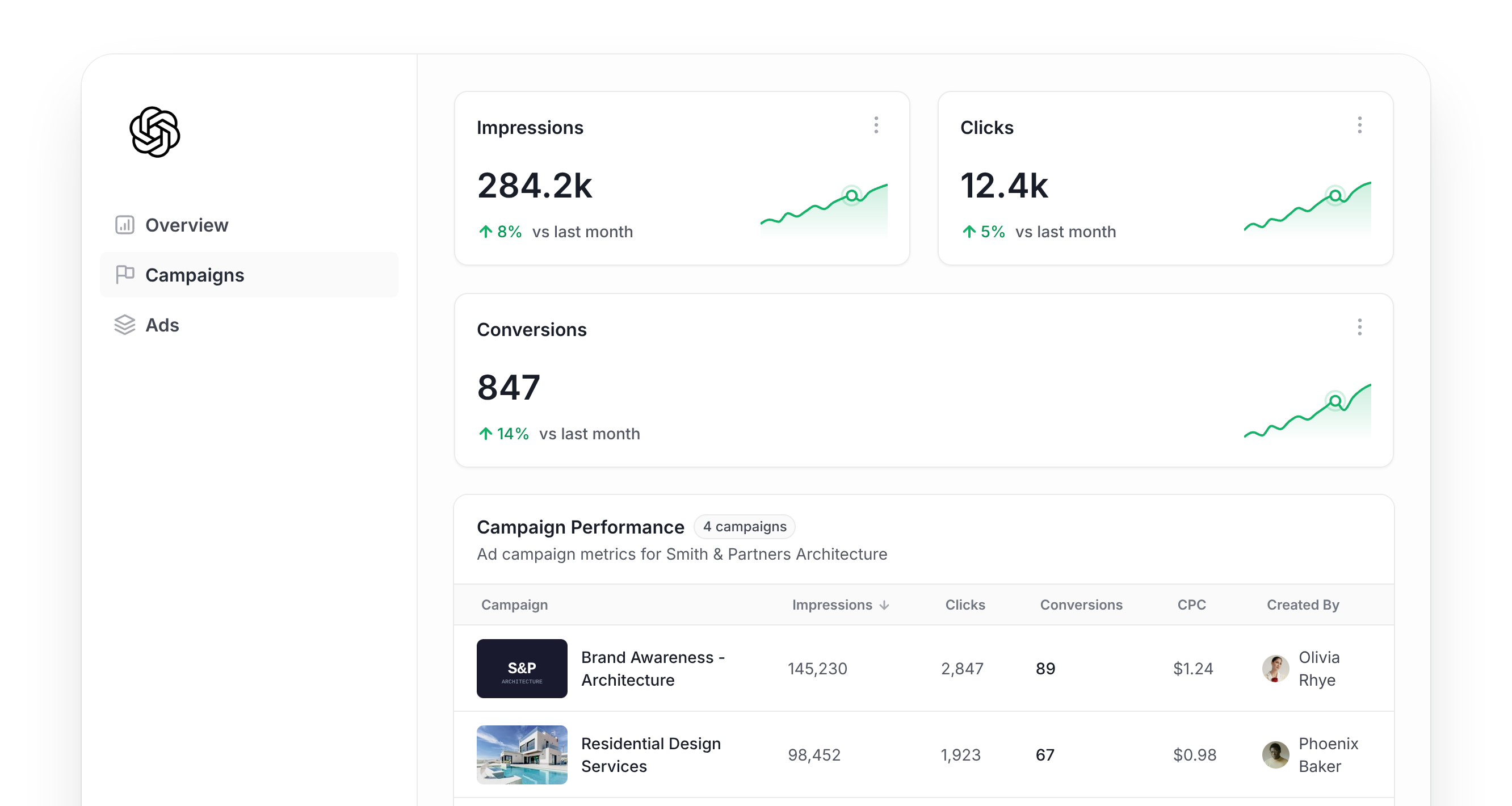
ChatGPT started showing ads in February 2026, but it was only open to select advertisers at first.
Then in May 2026, OpenAI opened its ad platform to everyone, and by October it said more than 100,000 advertisers had signed up across 89 countries.
That's a highly generic, relatively uninformative number. We wanted to see how common ChatGPT Ads are among ordinary businesses, and how it compares to other ad platforms like Google Ads, Meta Ads, etc.
Fortunately, between Converly and our sister product Attributer, we have access to data on roughly 9 million leads from over 2,500 SMBs in 70+ countries.
So we decided to jump into the data and see what we could learn about who's using ChatGPT Ads and how it compares to other ad platforms like Google Ads and Meta.
Only 4% of businesses are using ChatGPT Ads
Of the 2,000+ businesses that use either Attributer or Converly to track their leads, only 4.4% were using ChatGPT Ads between May and October 2026.
That's a long way behind Google Ads, which 75% of them use.
But for a platform that has been open to everyone for six months, it's further along than you might expect. It's already ahead of LinkedIn Ads (1.8%) and TikTok Ads (0.5%), and about a third of the way to Microsoft Ads (14.5%), which has been selling search ads since 2006.
| Category | Value |
|---|---|
| Google Ads | 75.1% |
| Meta Ads | 22.8% |
| Microsoft Ads | 14.5% |
| ChatGPT Ads | 4.4% |
| LinkedIn Ads | 1.8% |
| TikTok Ads | 0.5% |
Adoption is speeding up, but stickiness is a problem
In May, just 0.1% of these 2,500+ SMBs were using ChatGPT Ads. By October, 4.4% had tried them at some point.
That's a big change, and it seems to be accelerating as well. October was the biggest month so far, with 1.4% (of the overall 4.4% who had used them) starting in that month alone. In fact, more than half of the businesses that have ever used ChatGPT Ads started using them in September or October.
- Have used ChatGPT Ads so far
- Using ChatGPT Ads that month
| Period | Have used ChatGPT Ads so far | Using ChatGPT Ads that month |
|---|---|---|
| May | 0.1% | 0.1% |
| Jun | 0.8% | 0.8% |
| Jul | 1.5% | 1.2% |
| Aug | 2% | 0.9% |
| Sep | 3% | 1.7% |
| Oct | 4.4% | 2.3% |
But stickiness seems to be a problem. Looking at the chart above, there are two lines:
- The top line is every business that has used ChatGPT Ads at any point since May. By October it had reached 4.4%.
- The bottom line is the businesses that were using ChatGPT Ads in that particular month. In October, it was at 2.3%.
Put simply, only about half of the businesses that have tried ChatGPT Ads were still using them in October. This suggests that some businesses are trying them out but abandoning them quickly (likely because they weren't seeing the results they were hoping for).
The businesses using them already do other ads
Almost nobody is starting their paid advertising with ChatGPT.
In fact, 94% of the businesses that tried ChatGPT Ads between May and October 2026 were also using Google Ads at the same time.
41% were also using Meta Ads, and 34% were also doing Microsoft Ads.
93.8% of businesses who are doing ChatGPT Ads are also doing Google Ads.
40.6% of businesses who are doing ChatGPT Ads are also doing Meta Ads.
34.4% of businesses who are doing ChatGPT Ads are also doing Microsoft Ads.
| Category | Value | Detail |
|---|---|---|
| Google Ads | 93.8% | 93.8% of businesses who are doing ChatGPT Ads are also doing Google Ads. |
| Meta Ads | 40.6% | 40.6% of businesses who are doing ChatGPT Ads are also doing Meta Ads. |
| Microsoft Ads | 34.4% | 34.4% of businesses who are doing ChatGPT Ads are also doing Microsoft Ads. |
And it would seem like the more successful a business is with Google Ads, the more likely it is to try ChatGPT Ads.
| Category | Value |
|---|---|
| Not using Google Ads | 1.1% |
| 1 to 49 Google Ads leads | 2.2% |
| 50 to 299 Google Ads leads | 6.3% |
| 300 or more Google Ads leads | 11.1% |
Of the businesses in our dataset who got 300+ leads from Google Ads over the six months, 11% of them had tried ChatGPT Ads. Compare that to businesses who got fewer than 50 leads from Google Ads over the six months, where only 2% had also tried ChatGPT Ads.
So far, it really looks like some of the more ad-focused businesses are trying it out on top of their advertising on other platforms. Less than 1% of the businesses in our dataset stopped doing Google Ads, Meta Ads, etc. when they started doing ChatGPT Ads.
Mid-sized businesses are moving first
Businesses with 51 to 200 staff are more than three times as likely to be using ChatGPT Ads as businesses with 10 or fewer staff.
| Category | Value |
|---|---|
| 1 to 10 staff | 1.9% |
| 11 to 50 staff | 4.5% |
| 51 to 200 staff | 6.9% |
| More than 200 staff | 5.8% |
This is likely due to the fact that businesses of this size are the most capable of moving on new platforms like this. They likely have some professional marketers on staff who are capable of setting up new ad platforms like ChatGPT Ads, but are also small and nimble enough to move fast on it without crazy lines of approvals.
It isn't just tech-forward businesses using it either
Agencies and software companies are leading the way, with around 9% of them using ChatGPT Ads. But of the ChatGPT advertisers in our dataset, the majority aren't in industries you would typically consider 'tech-forward'.
They include law firms, financial advisers, recruitment firms, landscapers, moving companies, tour operators, roofers and more.
In fact, travel and leisure (6.7%), professional services (5.9%) and real estate (5.6%) all sit above the 4.4% average.
| Rank | Category | Value |
|---|---|---|
| 1 | Agencies and media | 9.3% |
| 2 | IT and software | 9.1% |
| 3 | Travel and leisure | 6.7% |
| 4 | Professional services | 5.9% |
| 5 | Real estate | 5.6% |
| 6 | Manufacturing | 4.2% |
| 7 | Construction | 3.6% |
| 8 | Healthcare | 2.2% |
| 9 | Education | 2% |
What this means for you
1. It's a greenfield market
Right now, barely anyone is using ChatGPT Ads (4.4% of businesses versus 75% for Google Ads).
That means competition is way lower within your industry, and therefore your cost per click is likely to be much cheaper as well (anecdotal evidence from places like Reddit also backs this up).
2. It's worth a test, with the right expectations
If you already get a steady flow of leads from Google Ads, then testing ChatGPT Ads should probably be on your to-do list. These days many people are using tools like ChatGPT to find lawyers, accountants, healthcare professionals, etc., so you'll want to make sure you're showing up.
But go in expecting a handful of leads a month, not a new main channel. Even among the businesses using it, Google Ads still sends 41 leads for every one from ChatGPT Ads (more on that in an upcoming report).
3. Accurate conversion tracking is critical (more so than other platforms)
Unlike other ad platforms (like Google and Microsoft Ads), you don't pick keywords to bid on. You simply tell ChatGPT Ads about your business and it uses AI to decide who to show your ads to and which conversations to insert them in.
This makes setting up accurate conversion tracking critical. If ChatGPT Ads doesn't know which conversations are generating actual leads for your business, then it will keep inserting your ads into the wrong conversations and burning your budget.
Converly is the best way to send conversions to ChatGPT Ads. It sends them server-side (to the Conversions API) so that ad blockers and browser privacy settings can't get in the way. It also sends the lead's name, email, phone, click ID, IP address and more with each conversion, so ChatGPT Ads has the data it needs to match conversions back to real users and the original ad they clicked (because if it can't match the conversion to a real person, the conversion doesn't get counted). It takes less than 10 minutes to set up and it's free to get started.
Conclusion
ChatGPT Ads is about 6 months old now, and only 4% of businesses have ever tried it. That means there's not a lot of competition, and the cost per click will be far cheaper than other ad platforms like Google and Microsoft.
So if nothing else, it's worth putting a small budget in and trying it out. Just remember to set up accurate conversion tracking, otherwise you're not really giving yourself much of a chance to be successful.
About the author

Aaron is the founder of Converly. With over 15 years of experience in digital marketing and SaaS, he's passionate about helping businesses track and optimise their ad conversions.