


Track Typeform form submissions as conversions in ChatGPT Ads
Learn how to send server-side conversions to ChatGPT Ads whenever someone submits a Typeform embedded on your website. No code required!
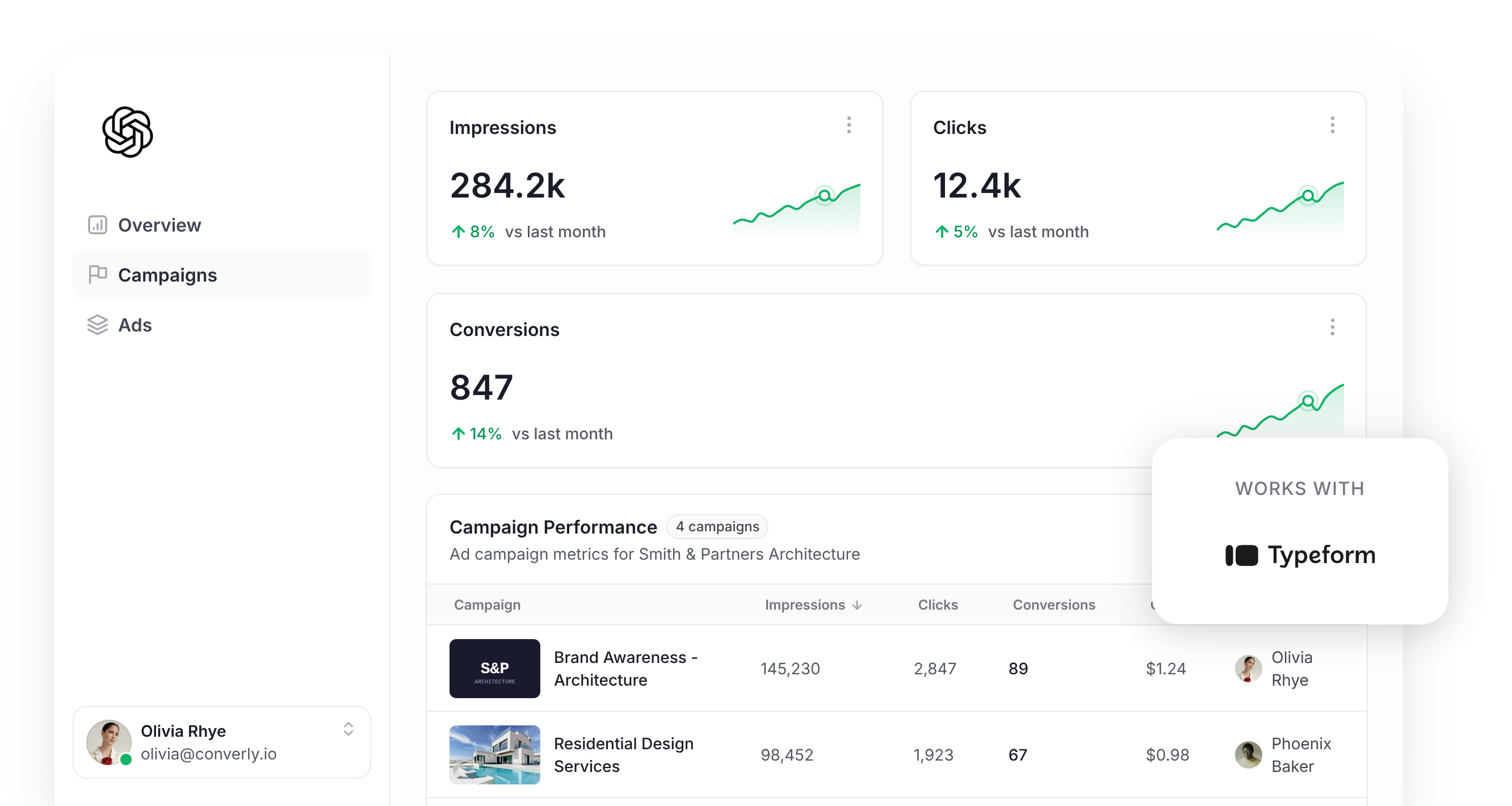
Thinking about using ChatGPT Ads to generate more leads for your business?
If you are, getting your conversion tracking right needs to happen before you spend a single dollar. Like almost every ad platform these days, ChatGPT Ads uses AI to figure out which people are most likely to turn into leads, and then shows your ads to more people who look like them.
But that AI can only be as smart as the conversion data you give it. When ChatGPT Ads has no visibility into which ad clicks actually became leads, it has nothing to learn from, so it keeps putting your ads in front of people who were never going to fill out your Typeform (which gets costly very quickly, especially when you're paying per impression).
It matters even more on ChatGPT Ads because you don't pick 'keywords' for your ads to appear on. Instead, you're trusting ChatGPT to slot your ad into conversations it thinks are relevant, and unless it knows which of those conversations went on to produce a lead, it can't work out where your ads belong in future.
So what does good conversion tracking in ChatGPT Ads look like, and how do you actually get it working?
In this guide, we'll show you the best way to send a conversion to ChatGPT Ads every time someone submits a Typeform on your website. We'll be using an approach called server-side tracking, and you won't have to touch any code to make it happen.
What proper conversion tracking looks like in ChatGPT Ads
There are 2 parts to getting conversion tracking right in ChatGPT Ads. The first is delivery (i.e. every conversion needs to actually make it back to the platform), and the second is data (i.e. each conversion needs to carry enough detail for ChatGPT Ads to match it back to a real person and the ad that brought them in).
Here's a closer look at both:
Ensuring proper delivery
You could simply install the ChatGPT Ads Measurement Pixel on your site and trigger a conversion when someone reaches your thank you page. Unfortunately, a large share of those conversions will never make it back to the ad platform thanks to things like ad blockers and browser-based privacy restrictions (which stop the ChatGPT pixel from loading when the visitor lands on your site).
In fact, studies show that over 30% of conversions are blocked from ever being delivered to the ad platform for this reason.
This is why OpenAI suggests sending every conversion back using two separate methods. The first is through the visitor's browser to the Measurement Pixel, and the other is from a server to OpenAI using the Conversions API (this is what's known as 'server-side tracking'). The idea is that when the browser version gets blocked, the server-side version is still there as a backup, so all your conversions should make it back to ChatGPT Ads successfully (one way or the other).
Sending the right data
Even if you do manage to successfully send the conversion back to ChatGPT Ads, the next hurdle is matching it back to a real person and the original ad they clicked (otherwise the conversion doesn't get counted). There are a couple of issues at play here, including:
- Browser Privacy Features - Safari and other privacy-focused browsers only allow tracking cookies to stay in the visitor's browser for a short time, which means someone who clicks your ad on a Tuesday and completes your Typeform the following Monday often can't be tied back to their original ad click.
- Switching Devices - People regularly click an ad on their phone and then return days later on their computer and complete the form. The pixel in the desktop browser knows nothing about the click on the phone, so the conversion can't be tied back to the original ad click.
- Switching Browsers - Lots of people use the ChatGPT app on their phone. When they click your ad, your site opens in a small browser window inside the ChatGPT app, and that window keeps its own cookies separate from the other browsers the user might have on their phone. So if they click your ad in the ChatGPT app but then come back later in their phone's default browser (Chrome, Safari, etc.), the conversion can't be tied back to the original ad click.
The solution to all these problems is sending additional data about the lead back to ChatGPT Ads with each conversion. This includes the lead's name, email and phone, as well as the Click ID (in ChatGPT Ads this is known as the oppref) and their IP address and user agent. This gives ChatGPT Ads the data it needs to tie the conversion back to a real user and the original ad they clicked, which means it will show up in your reports (if they can't tie a conversion back to the original ad they clicked, no conversion gets counted).
3 simple steps to send proper, server-side conversions to ChatGPT Ads from Typeform
Now that you understand what solid ChatGPT Ads conversion tracking involves, let's walk through setting it up with Converly. There are just 3 steps:
Step 1: Build your Conversion Flow in Converly
Converly is a conversion tracking tool built to make sending conversions from Typeform to ChatGPT Ads super easy.
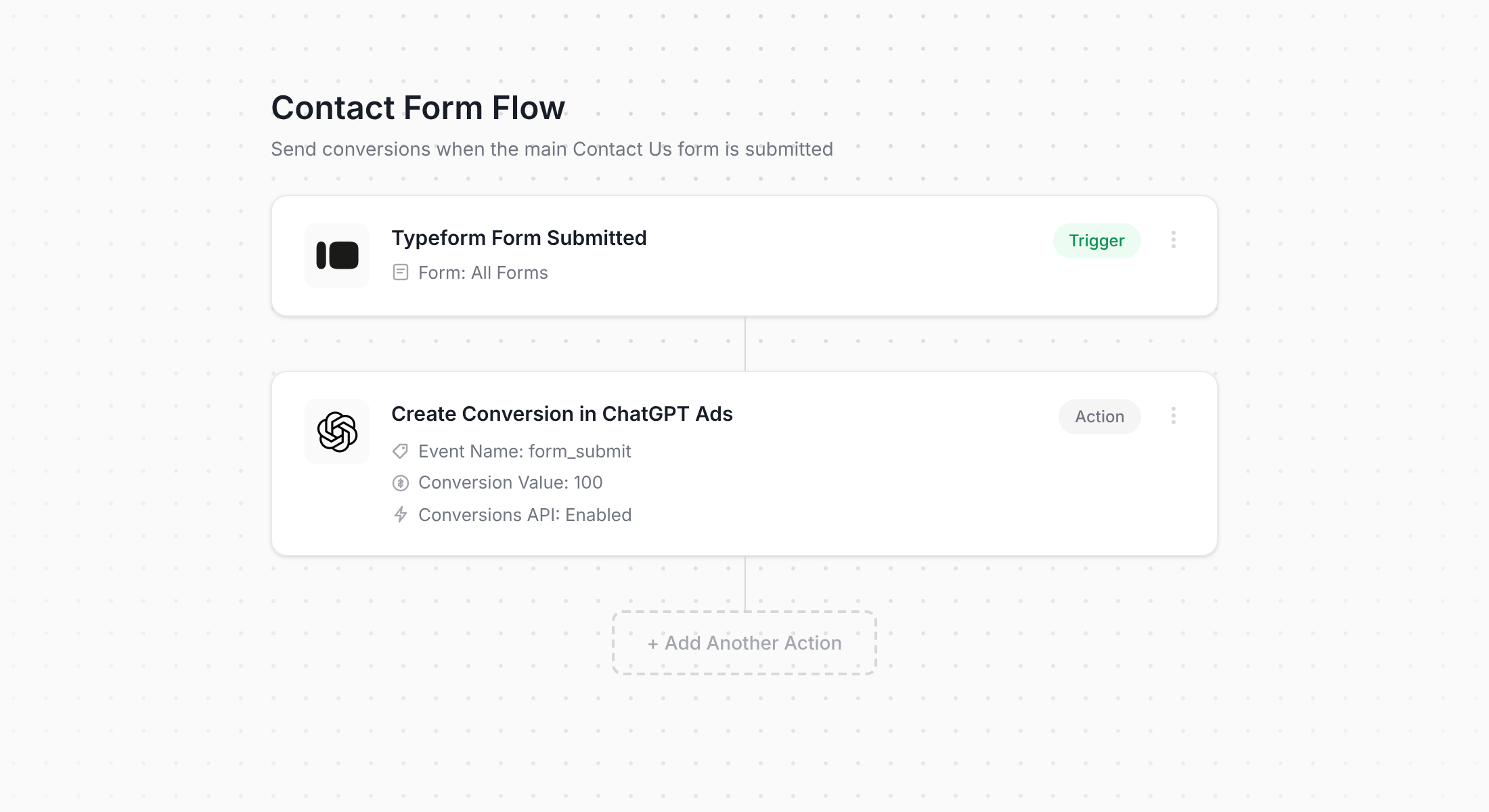
The screenshot above shows Converly's workflow builder. Anyone who has put together an automation in Zapier or HubSpot will recognise the layout instantly.
First, you select your trigger (a visitor submitting a Typeform on your website), and then you choose what should happen next (a conversion being sent to ChatGPT Ads). That's genuinely it. A couple of clicks later, your server-side conversion tracking for ChatGPT Ads is live.
And it's even easier if you use an AI assistant like Claude or ChatGPT. Connect it to your Converly account, ask it to 'Set up ChatGPT Ads conversion tracking for my Typeforms', and it will set up the whole thing and test it works for you!
Step 2: Add the Converly code to your website
Once your Conversion Flow is built and published, Converly gives you a small code snippet to add to your website.
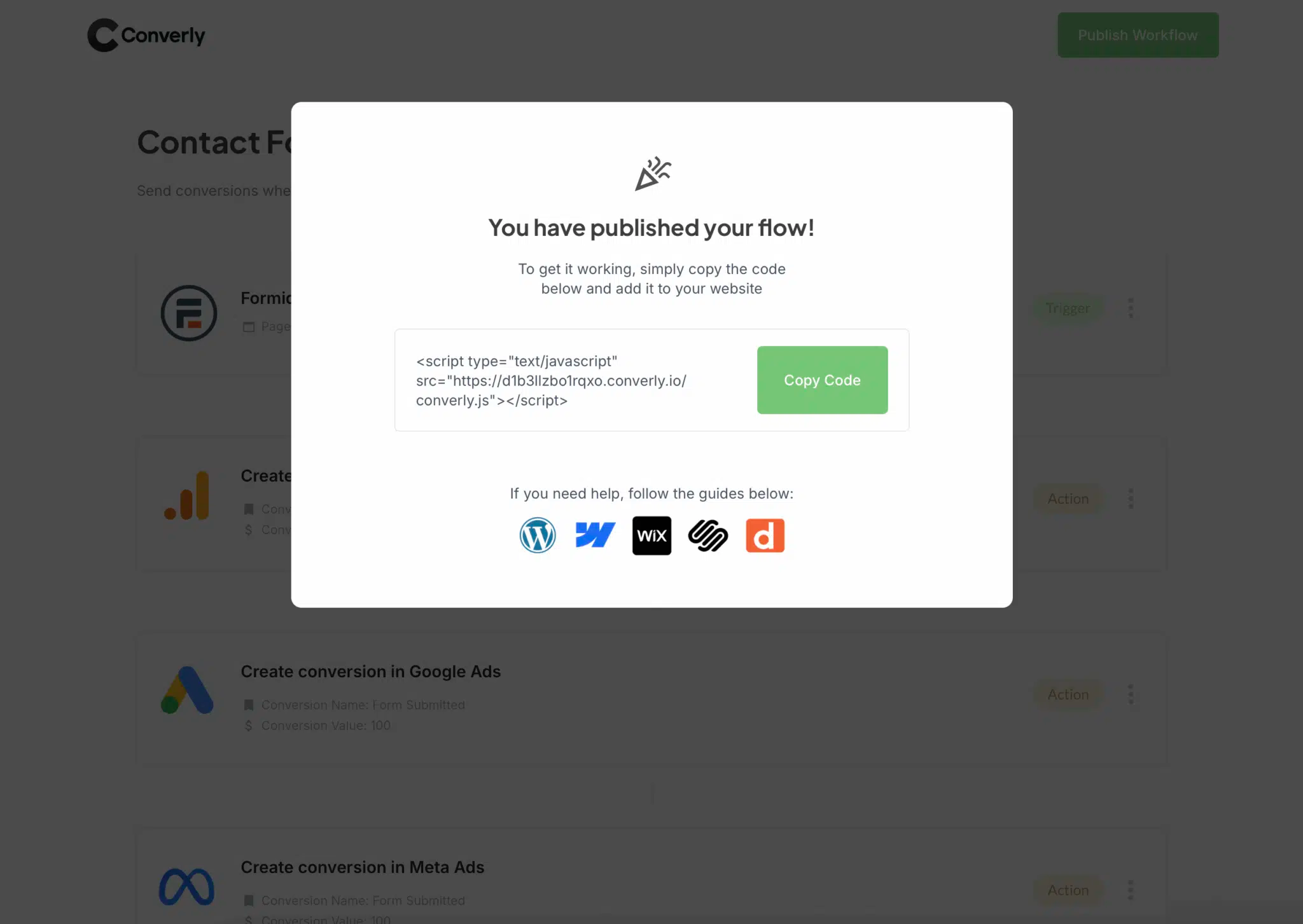
Because your Typeform lives on typeform.com and appears on your site through an iFrame, the snippet needs to go on the website that hosts that iFrame (so your main marketing site where the user completes the Typeform essentially). On WordPress, Webflow, Squarespace and most other website builders, you'll find a Header or Custom Code setting where you can paste it in. Or if Google Tag Manager is already running on your site, adding the snippet through there works just as well.
Step 3: Test it works
With the code in place, visit your website and complete your embedded Typeform yourself, just like a real person would.
After that, return to Converly and click 'Logs' in the main navigation.
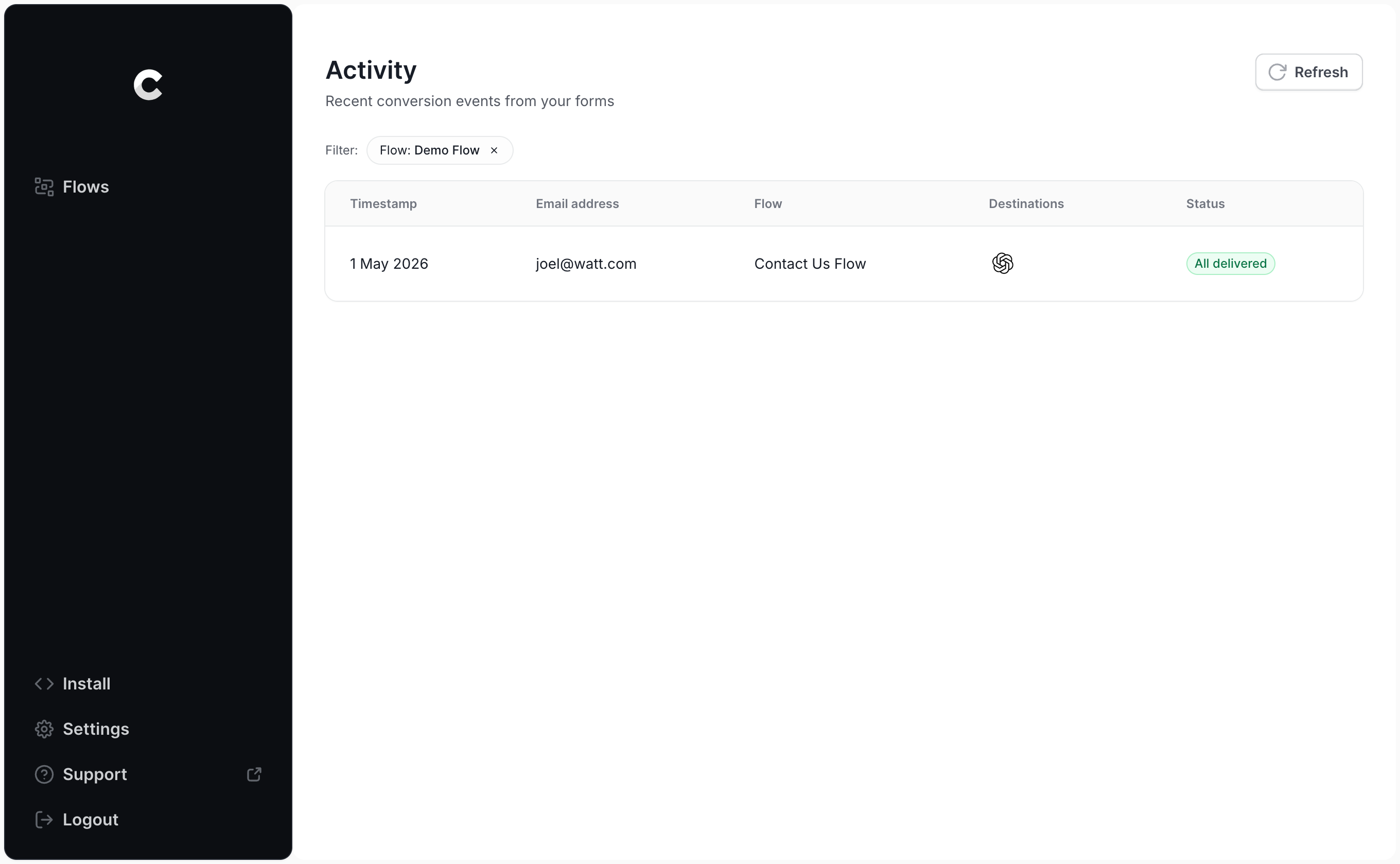
Locate your test response in the list and click on it. Converly will show you everything it captured, along with whether the conversion made it to ChatGPT Ads.
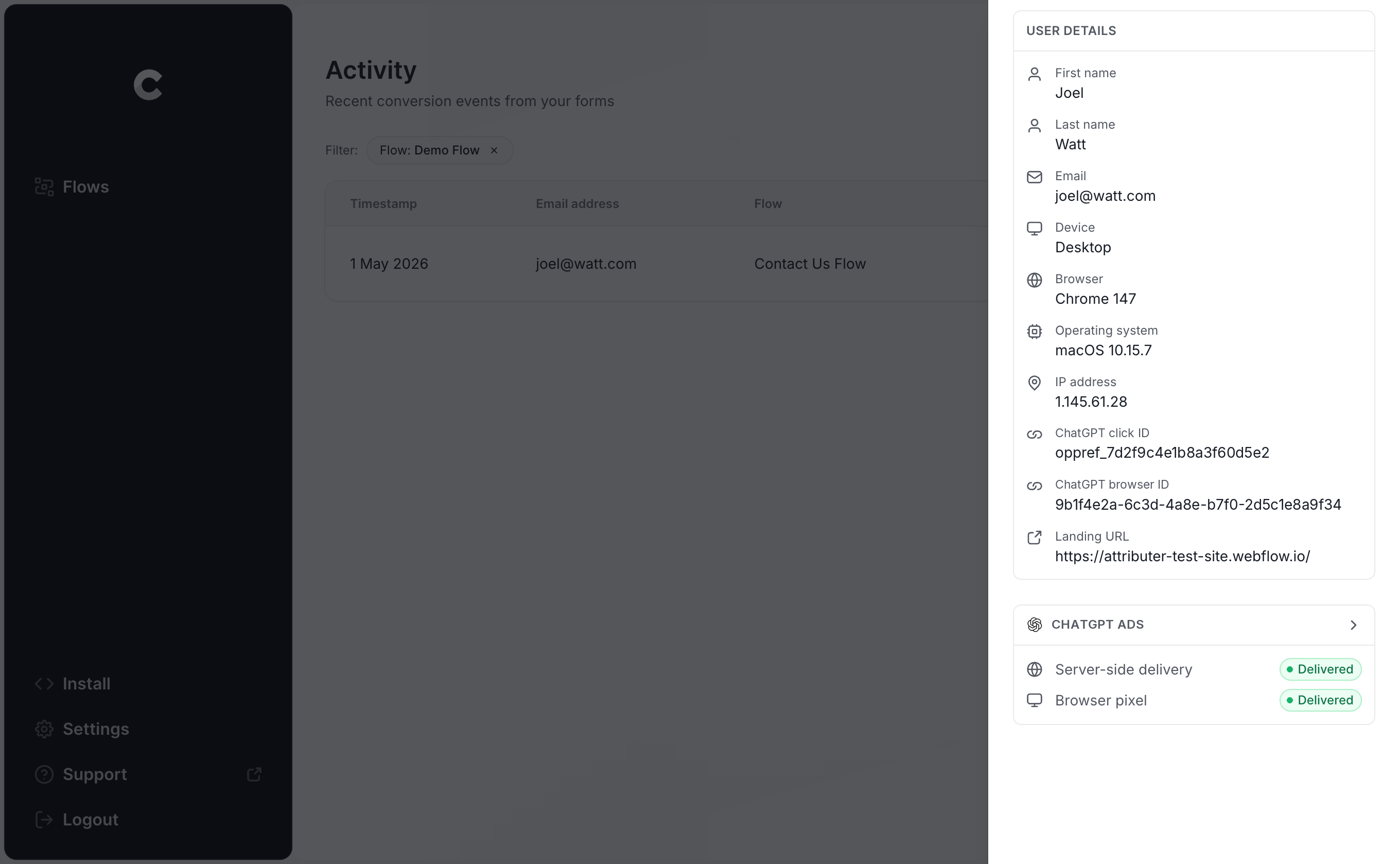
For a closer look, you can open up the exact payload that went to ChatGPT Ads and the response that came back from OpenAI's server.
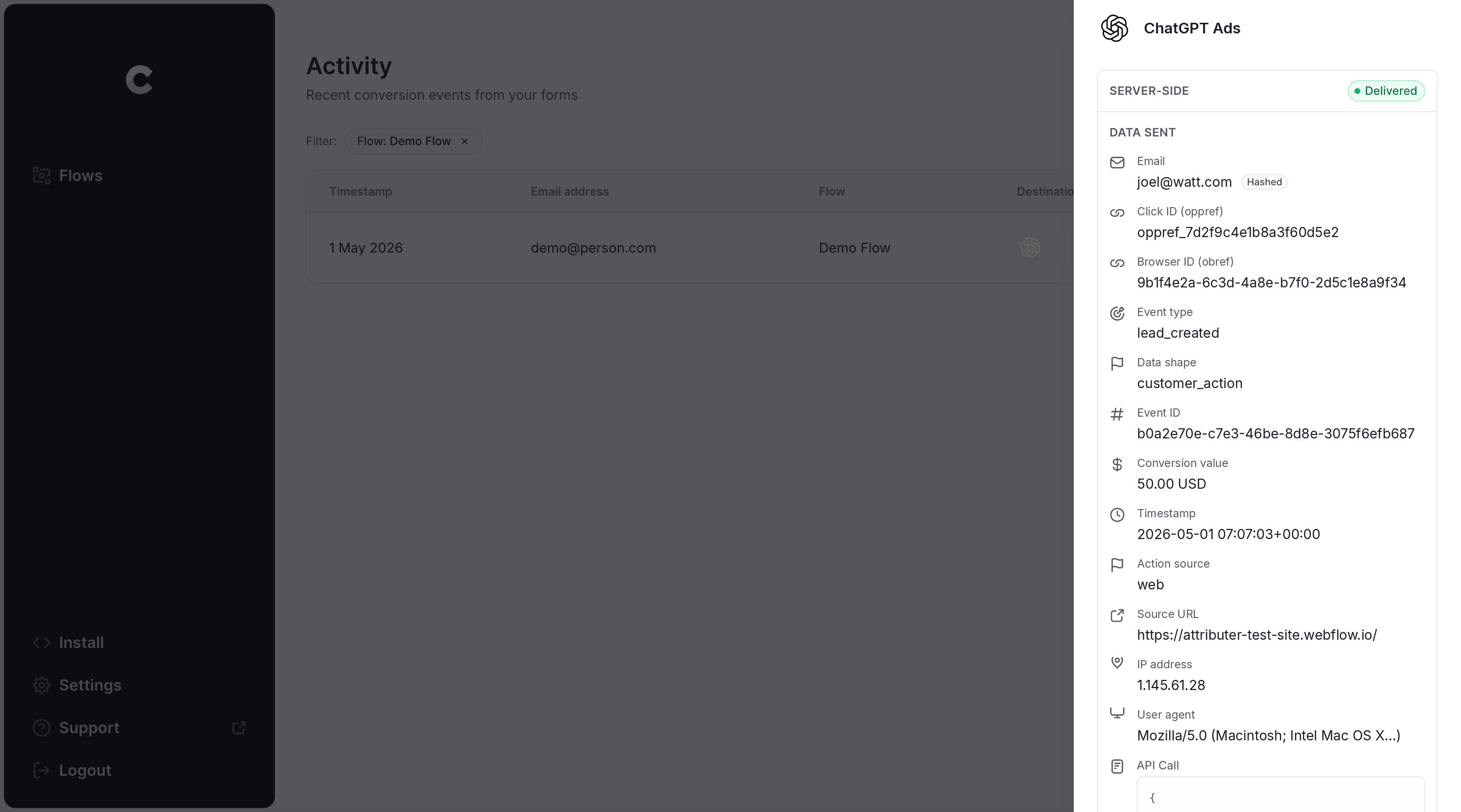
If the log shows your test response was sent to ChatGPT Ads successfully, your conversion tracking is good to go. Most people get through the entire setup in under 5 minutes.
Why Converly is the best way to send conversions to ChatGPT Ads from Typeform
There's more than one way to get a conversion into ChatGPT Ads when someone completes a Typeform, so what makes Converly the better choice? Here's why so many marketers use it:
1. Easy to set up
Doing this on your own means building directly on OpenAI's Conversions API. You'd need to write code that detects when an embedded Typeform has been submitted, picks up the click ID and browser cookie, fetches the lead's details via the Typeform API, hashes them using SHA-256, and packages everything into exactly the format OpenAI requires. Then you'd still have to handle API keys, deduplication and retries yourself.
Converly takes all of that off your plate. Pick a trigger (a Typeform submission), pick an action (a conversion sent to ChatGPT Ads), and let Converly handle everything else. You won't write any custom code or juggle any API keys, and it'll just work.
Alternatively, if you are using an AI tool like Claude or ChatGPT, then connect it to Converly, tell it to 'Set up ChatGPT Ads tracking for my Typeforms', and it will do the setup for you!
2. Not affected by ad blockers and privacy restrictions
If you only use the ChatGPT Ads Measurement Pixel and skip sending conversions server-side through the Conversions API, a meaningful chunk of your conversions won't ever make it to OpenAI. Ad blockers and privacy-focused browsers prevent the pixel from loading on the visitor's device when they first land on your site, so nothing they do can be tracked.
How big of a deal is this? One study of over 7 million conversions found browser-based tracking failed to record roughly 30% of conversions. So it's a big number.
Converly delivers each conversion both ways (in the browser to the ChatGPT Measurement Pixel, and server-side to the Conversions API), which means your conversions have the best chance of getting through regardless of the ad blocker or privacy settings a visitor has in place.
3. Works across devices
It's very common for a lead to discover your site on one device (say, scrolling on their phone on the train) and then return later on their computer to finally complete your Typeform.
When your tracking relies on something like thank you page visits, that conversion can't be connected to the ad click that started it all, because the 2 events took place in separate browsers on separate devices.
Converly solves this issue by capturing the click ID (the oppref) and sending it to ChatGPT Ads alongside the lead's name, email address, and phone number. This gives ChatGPT Ads everything it needs to link the conversion to a real person and the ad they originally clicked, even if that click happened on a different device several weeks earlier.
4. Sends more data
As soon as a visitor arrives on your website, Converly records the ChatGPT click ID (known as the oppref), the browser cookie dropped by the ChatGPT Ads pixel, and the visitor's user agent. Later, when they complete your Typeform, Converly pairs that information with their name, email address and phone number and passes all of it to ChatGPT Ads.
This means ChatGPT Ads can match every conversion to the ad click that produced it, and you get much more accurate conversion numbers as a result.
5. Supports multiple tools and platforms
Converly connects with more than 100 form builders, scheduling tools, chat widgets and other apps. And when it comes to sending conversions, it can send them to ChatGPT Ads, Google Ads, Meta Ads, LinkedIn Ads, Microsoft Ads, Google Analytics and many more.
That means if Google Ads or Meta Ads are part of your mix alongside ChatGPT Ads, you don't need a separate setup for each. Just add them as additional actions in the Conversion Flow you already have, and each Typeform submission will go to every platform at once. And when a new ad platform appears down the track, connecting it is just a few clicks instead of starting from scratch.
6. Gives you a full conversion log and email alerts
Most other ways of tracking ChatGPT Ads conversions (Google Tag Manager being a good example) can't tell you whether things are working or not. You might test it on day one, but if someone later edits the Typeform, changes the embed, rotates an API key, or adjusts a setting in ChatGPT Ads Manager, your tracking can stop working, and you wouldn't know.
Converly takes the guesswork out of conversion tracking. You get a complete log of every person that completes your Typeforms, and it shows the data that was captured, what went to ChatGPT Ads, and whether it was accepted.
On top of that, you can turn on email notifications so that you get an email for every conversion (including whether it was delivered to ChatGPT Ads or not). So if anything ever goes wrong, you'll know about it straight away.
2 things you can do when you properly send conversions to ChatGPT Ads from Typeform
When reliable conversion data is flowing from your Typeforms into ChatGPT Ads, 2 things become possible that you simply can't do without it.
1. See which campaigns and ads actually produce leads
Without proper conversion tracking, all ChatGPT Ads can report on is impressions and clicks, and clicks won't pay the bills.
Once accurate conversion data is coming through, you'll be able to see exactly how many leads each campaign and ad is generating, what each lead is costing you, and where the best opportunities to grow are hiding.
2. Let OpenAI's algorithm find you more of the right people
ChatGPT Ads uses AI to decide not just who sees your ad, but which conversations it appears in. Every conversion you send teaches it which of those conversations actually produced real leads for your business, which ultimately means it gets better at putting your ads in the right conversations moving forward (instead of burning your budget showing your ads in conversations that wouldn't lead to conversions).
Wrap Up
If you want a conversion to be sent to ChatGPT Ads every time someone submits a Typeform on your website, Converly is the easiest and most reliable way to do it.
Since it sends conversions directly to OpenAI's servers, ad blockers and privacy-focused browsers can't stop them from getting through. And because it sends the lead's name, email, phone, click ID, etc., each conversion has the best possible chance of being matched back to a real user and the original ad they clicked (which means it will actually show in your reports).
Best of all, you can be set up in a few minutes, and there's a 14-day free trial (no credit card required), so get started today!
About the author

Aaron is the founder of Converly. With over 15 years of experience in digital marketing and SaaS, he's passionate about helping businesses track and optimise their ad conversions.