


Track Tally form submissions as conversions in ChatGPT Ads
Here's the best way to send server-side conversions to ChatGPT Ads whenever someone submits a Tally form on your website.
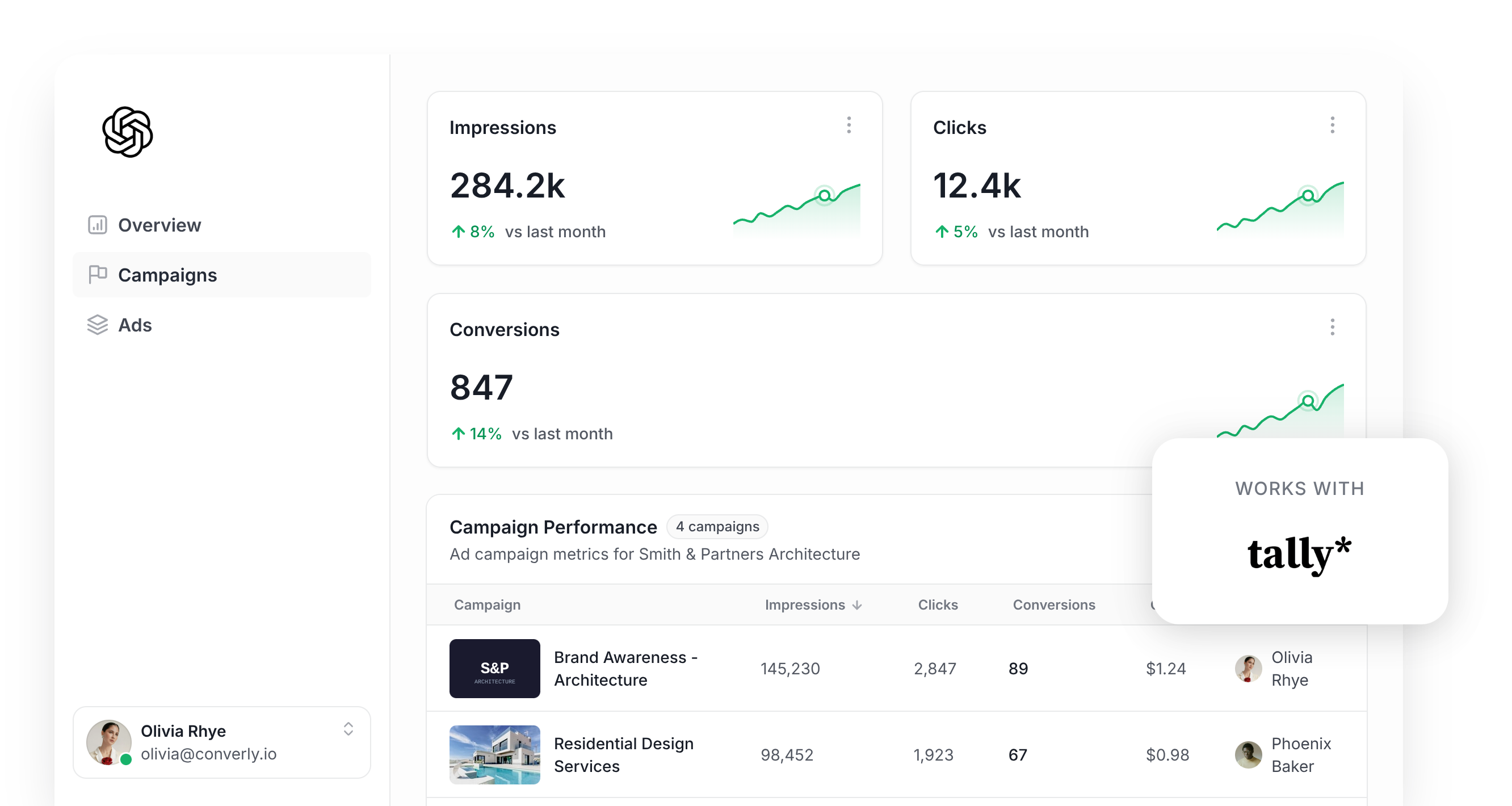
Thinking about using ChatGPT Ads to generate more leads for your business?
If so, you'll want to make sure your conversion tracking is set up properly. ChatGPT Ads uses advanced AI to work out which people are most likely to turn into leads, and it then shows your ads to more people who look like them.
To do that well, though, you have to give the AI good conversion data. When ChatGPT has no visibility into which ad clicks actually turned into leads, it can't tell what a good prospect for your business looks like, and it will end up burning your budget showing your ads to people who were never going to convert.
It matters even more in ChatGPT Ads than it does on a platform like Google Ads. With ChatGPT Ads you don't get to pick ‘keywords’, so you're trusting ChatGPT to place your ad in the right conversations. If nobody ever tells it which of those conversations led to a conversion, it has no way to learn which conversations it should show your ads in moving forward.
So what does good conversion tracking in ChatGPT Ads look like, and how do you get it working?
In this article, we'll show you the best way to send a conversion to ChatGPT Ads every time a visitor submits a Tally form on your website.
What proper conversion tracking looks like in ChatGPT Ads
There are 2 things you need to get right with ChatGPT Ads conversion tracking. First, every conversion has to actually make it back to ChatGPT Ads. Second, each of those conversions needs to include enough information for ChatGPT Ads to match the conversion back to a real person and the ad they initially clicked.
Here's why those 2 things are important:
Getting every conversion delivered
If you just install the ChatGPT Ads Measurement Pixel and fire a conversion whenever someone lands on a thank you page, then you are relying entirely on the visitor's browser to send the conversion over to ChatGPT Ads, and ad blockers and browser privacy features block that from happening regularly.
You'd be surprised how much data disappears as a result. In fact, industry research shows that 30% of conversions are lost this way. So essentially, if you only just use the Measurement Pixel, 3 in 10 conversions won't actually make it back to ChatGPT Ads.
To get around this, OpenAI recommends sending each conversion 2 different ways. The first travels through the visitor's browser via the Measurement Pixel, while the second goes directly from a server to OpenAI via the Conversions API (this is what people mean by "server-side tracking"). That way, if a browser blocks the pixel, the server-side conversion still gets through.
Making sure each conversion can be matched
Getting the conversion to ChatGPT Ads is only half the job. Once it arrives, ChatGPT Ads has to match it back to a real ChatGPT user and the original ad they clicked, and if it can't do that, the conversion won't be counted at all (ad platforms don't count conversions unless they can match them to a real user and a real ad click).
There are a couple of things that make this harder than you'd think:
- Browser privacy features - Privacy-focused browsers like Safari clear out tracking cookies after a short period (usually 7 days or less). Imagine someone clicks your ad on a Monday but comes back the following Tuesday and completes your Tally form. By then, the cookie connecting them to the original ad click has already been wiped, so they can't be matched.
- Switching devices - It's extremely common for people to click your ad on one device (e.g. their phone) and then return a few days later on their laptop or desktop to submit your form. Since the click and the submission happened on separate devices, there's no single cookie that can connect the two together, so the conversion can't be matched back to the original ad click.
- Switching browsers - Lots of people use the ChatGPT app on their phone, and clicking an ad opens your site in a little browser window inside that app. That in-app browser keeps its cookies completely separate from the phone's main browser, so if the person comes back later in Safari or Chrome and fills in your Tally form, ChatGPT Ads has no way of linking it to the original click.
You can solve all 3 of these problems by sending more information about the lead with every conversion. That includes their name, email address and phone number, along with the Click ID (which ChatGPT Ads calls the oppref), the lead's IP address and user agent, and more. With all of that extra information in hand, ChatGPT Ads can match the conversion to a real user (and from there, to the exact ad that user clicked) and it will actually show up as a conversion in your reports.
3 simple steps to send proper, server-side conversions to ChatGPT Ads from Tally Forms
So now you know what good conversion tracking looks like, here's the easiest way to set it up for the Tally forms on your website.
Step 1: Build your Conversion Flow in Converly
Converly is a conversion tracking tool that makes it easy to send proper, server-side conversions from Tally Forms to ChatGPT Ads.
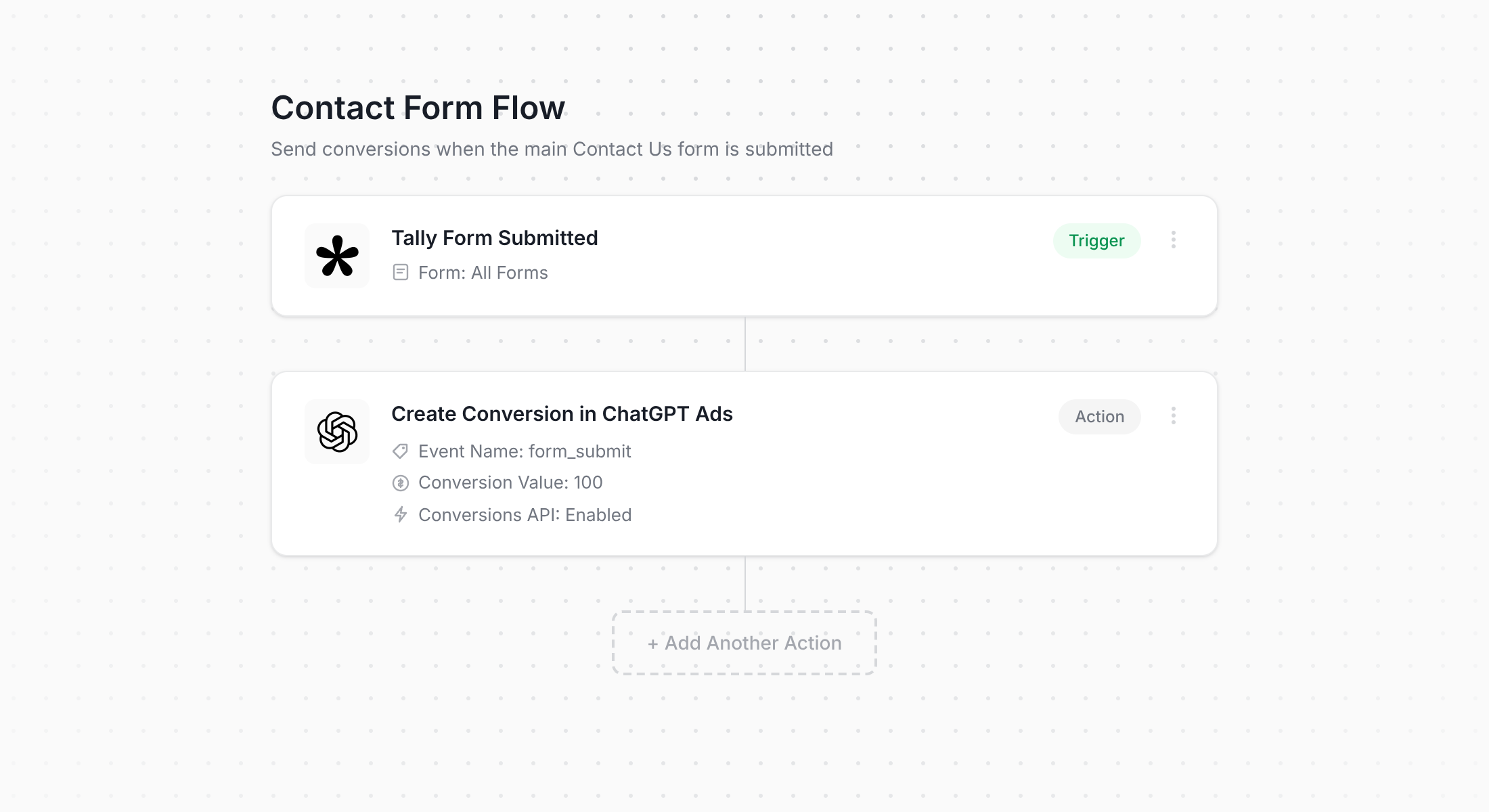
The screenshot above shows the Converly flow builder. If you've ever used something like Zapier (or connected Tally to another app using one of its integrations), it will feel very familiar.
First you choose a trigger (in this case, someone submitting one of your Tally forms), then you choose what should happen next (like a conversion being sent to ChatGPT Ads). That really is the whole process. With just a few clicks, you've got server-side conversion tracking for ChatGPT Ads ready to go.
You can make it even quicker with an AI assistant like Claude or ChatGPT. Install the Converly plugin, tell it to 'Set up ChatGPT Ads conversion tracking for my Tally forms', and it will put the whole thing together for you!
Step 2: Add the Converly code to your website
After you've built and published your Conversion Flow, Converly will give you a small snippet of code to put on your website.
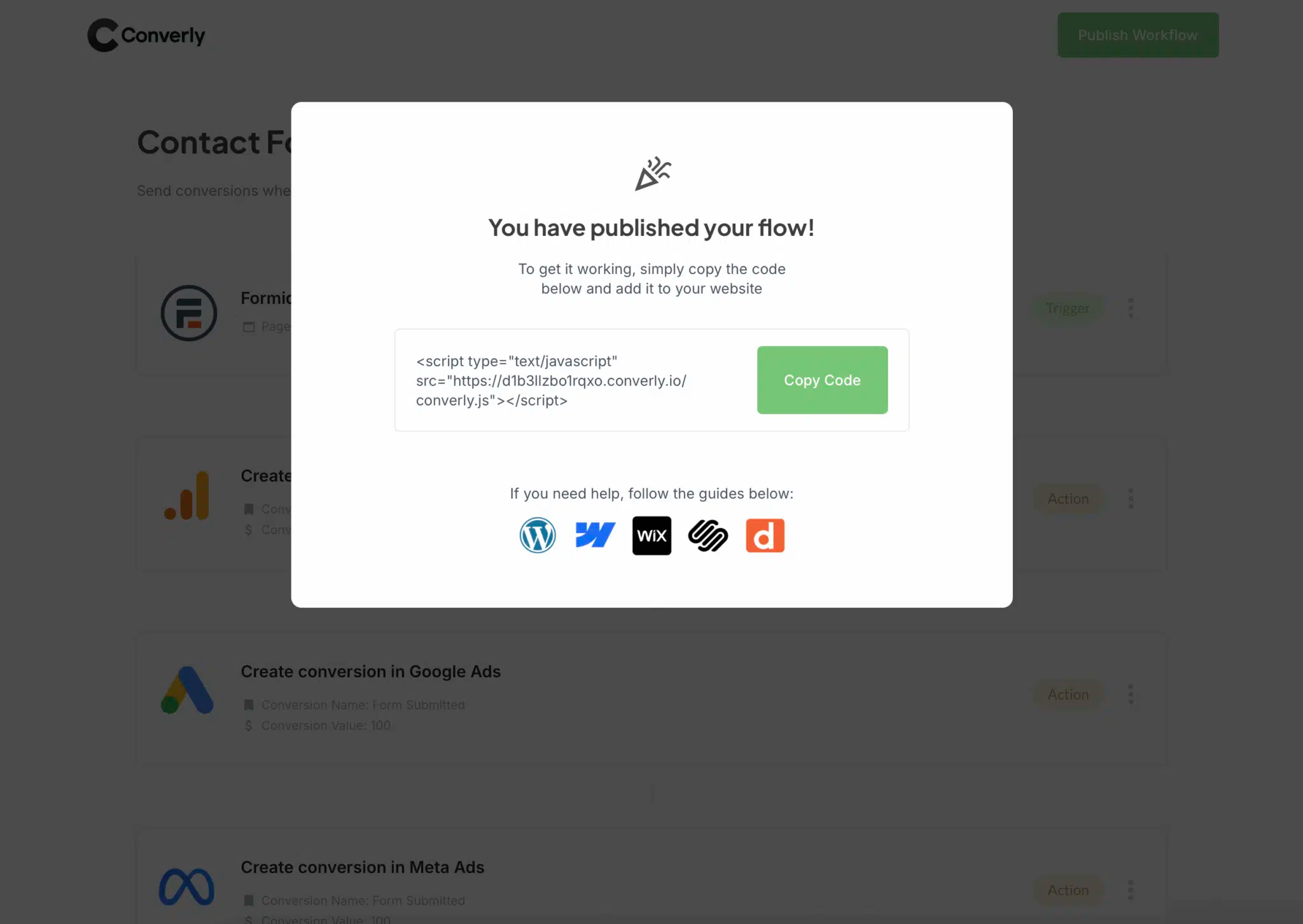
Since Tally forms are normally embedded into your marketing website, the snippet needs to go on the marketing site that hosts the embed rather than on Tally itself.
If your Tally form lives on a Webflow, Wix or Squarespace site (for example), you can usually just paste the code into the custom code area of your site settings so it loads in the head of every page. On WordPress, a plugin like Insert Headers and Footers will do the job, and if you're already running Google Tag Manager, you can add the snippet there instead.
Step 3: Test it works
The last thing to do is visit the live page where your Tally form is embedded and submit it yourself.
When that's done, head back into Converly and click 'Logs' in the main menu.
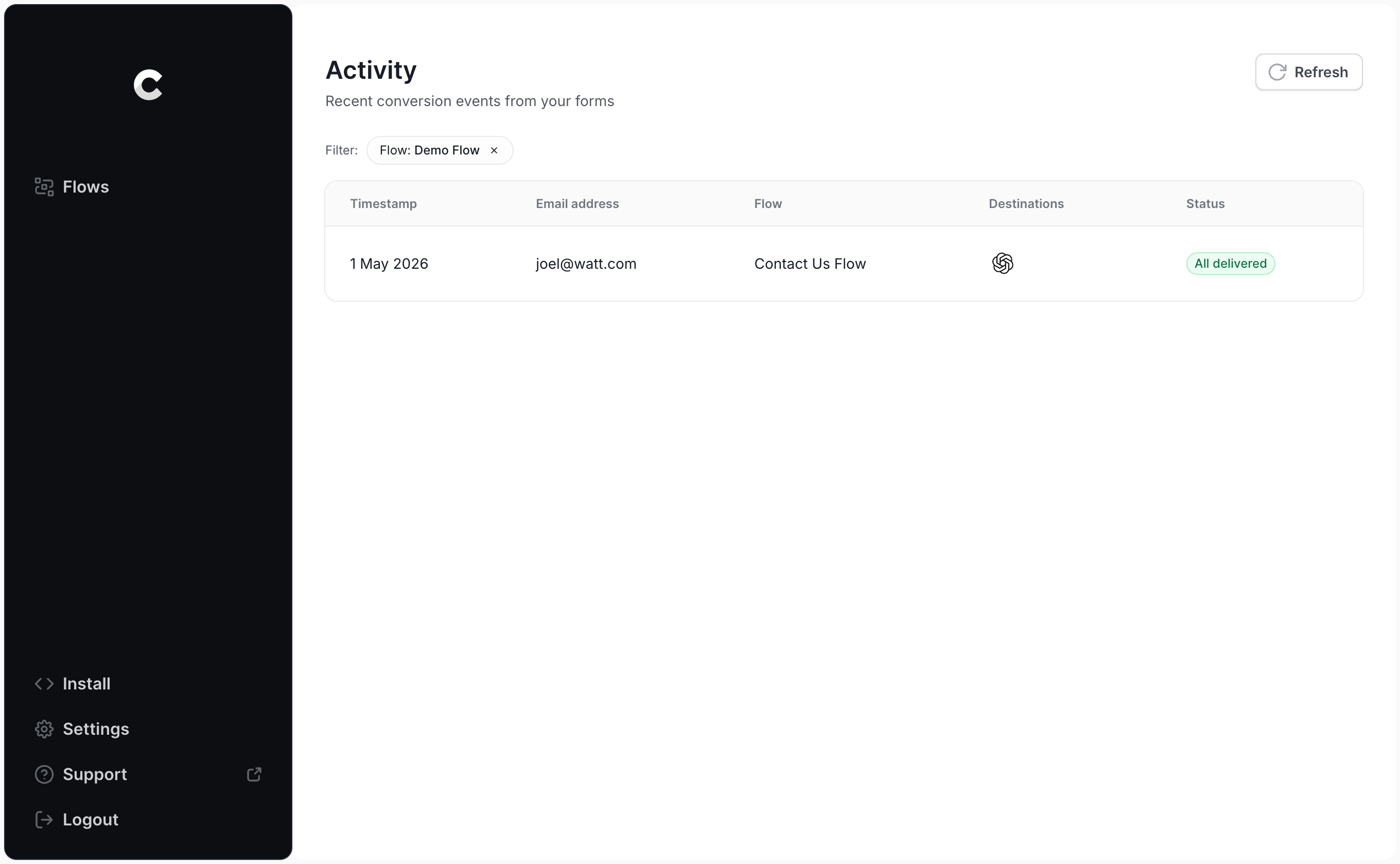
Look for your test submission in the list and open it up. Inside, you'll find all the information Converly captured from your Tally form, plus whether the conversion made it through to ChatGPT Ads.
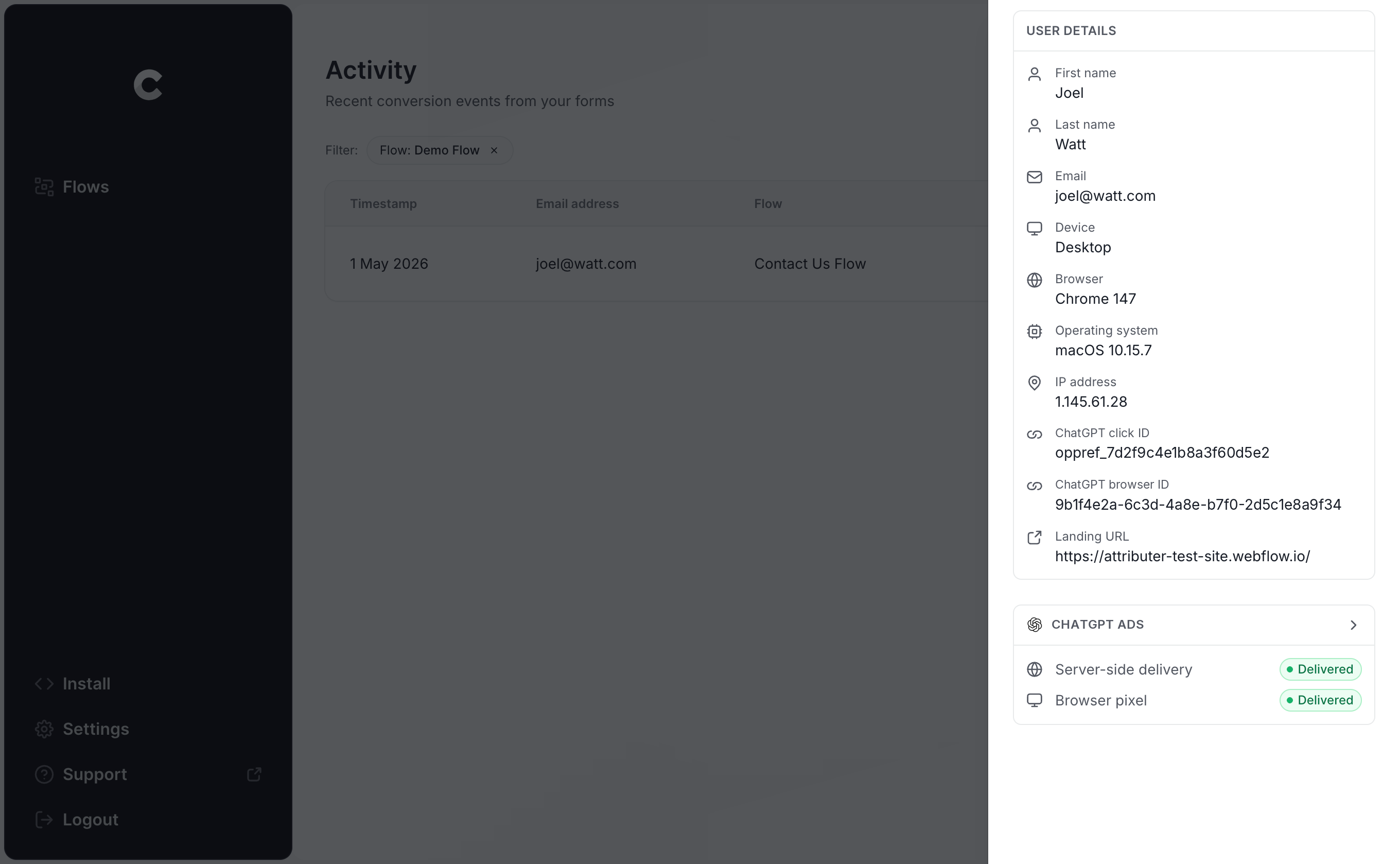
For anyone who likes to see what's happening under the hood, you can also check the exact payload Converly sent to ChatGPT Ads (the click ID, browser ID and hashed email address, for example) and the response that came back from OpenAI's server.
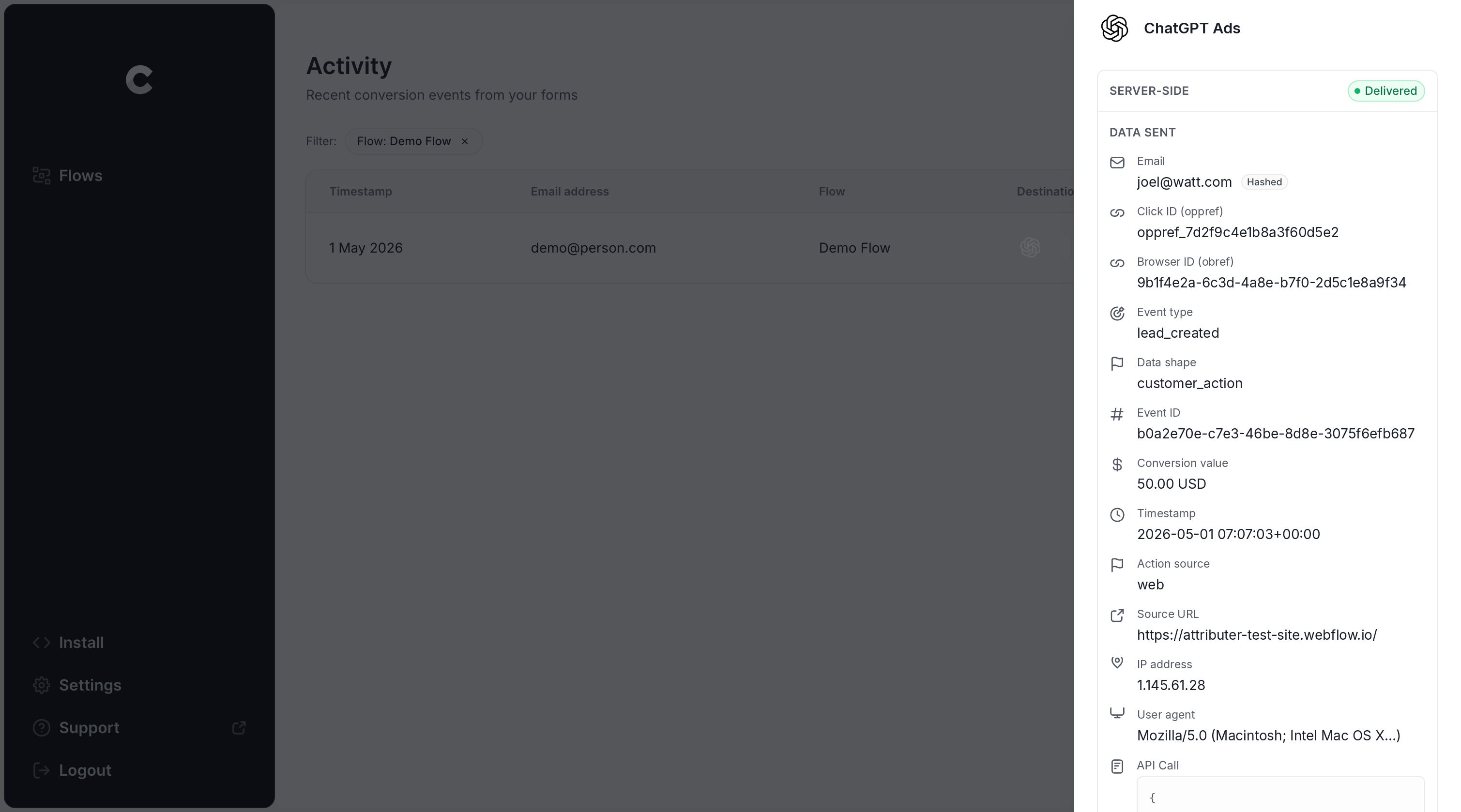
Once you can see your test submission in the log, that's it. Your conversion tracking is live and conversions are flowing server-side into ChatGPT Ads. For most people, the entire setup takes less than 5 minutes.
Why Converly is the best way to send conversions to ChatGPT Ads from Tally Forms
There's more than one way to get a conversion into ChatGPT Ads when someone submits a Tally form, so why go with Converly? Here's what sets it apart:
1. Easy to set up
If you tried to build all of this yourself, you'd be in for a lot of work. You'd need to write code that detects when a Tally form has been submitted, grabs the click ID and browser cookie, extracts the name, email address and phone number from the form, hashes them with SHA-256, builds the payload in the exact format OpenAI wants, and then sends it off. On top of that, you'd have to store API keys securely and handle deduplication, retries, consent management and more.
Converly takes care of every bit of that for you. You just choose a trigger (a Tally Forms submission) and an action (a conversion sent to ChatGPT Ads), and Converly handles the rest. You don't write any custom code or juggle API keys, you just get conversion tracking that works.
And if you're already using an AI tool like Claude or ChatGPT, all you have to do is install the Converly plugin and ask it to 'Set up ChatGPT Ads tracking for my Tally forms'. It will handle the whole setup for you!
2. Not affected by ad blockers and privacy restrictions
When you rely only on the ChatGPT Ads Measurement Pixel (and don't also send conversions server-side via the Conversions API), plenty of your conversions will never make it back to OpenAI, because ad blockers and privacy-focused browsers stop the pixel from loading when the visitor lands on your site.
How big is the gap? One study looking at over 7 million conversions found that browser-based tracking failed to record around 30% of them. Put another way, nearly a third of your conversions would simply never be counted if you just used the Measurement Pixel.
Converly sends each conversion down both paths (through the browser to the ChatGPT Measurement Pixel and server-side to the Conversions API), so they should get to ChatGPT Ads regardless of which ad blocker or privacy settings your visitors have.
3. Works across devices
Leads very often discover your site on one device (like while asking ChatGPT a question on their phone over lunch) and then return and complete your Tally form on their computer at a later time.
With only the ChatGPT Measurement Pixel in place, you can't connect that conversion back to the original ad click because they happened in separate browsers on separate devices (so there's no cookie tying both together).
That's a problem Converly fixes. It captures the click ID (the oppref) and sends it to ChatGPT Ads along with the lead's name, email address, and phone number. With that information, ChatGPT Ads can match the conversion to a real person (and the ad that person originally clicked) even if that click happened weeks earlier on a different device.
4. Sends more data
As soon as someone lands on your website, Converly records the ChatGPT click ID, the browser cookie set by the ChatGPT Ads pixel, and their user agent, and stores them for later. Then, when that visitor submits one of your Tally forms, it captures their name, email and phone from the form. It then combines all of this data together and sends it over to ChatGPT Ads with each conversion.
With all of this data, ChatGPT Ads can connect each conversion back to a real ChatGPT user (and subsequently the ad they clicked), and ultimately you get much more accurate conversion data.
5. Supports multiple tools and platforms
Converly integrates with more than 100 form builders, scheduling tools, chat widgets and more. And on the destination side, it can send conversions to ChatGPT Ads, Google Ads, Meta Ads, LinkedIn Ads, Microsoft Ads, Google Analytics and plenty of other platforms.
That means if you're running Google Ads or Meta Ads as well as ChatGPT Ads, you don't need a separate setup for each of them. Just add them as additional actions in your Conversion Flow and every Tally Forms submission is sent to all of them at once. Plus, when you want to test a new ad platform down the track, connecting it is a matter of a few clicks.
6. Gives you a full conversion log and email alerts
Most other methods for tracking ChatGPT Ads conversions (e.g. Google Tag Manager) don't offer an easy way to check that everything is still working.
You might test it all on the day you set it up, but if someone later changes where your Tally form redirects after submission, swaps the embed for a new version of the form, or tweaks a setting in ChatGPT Ads Manager, your tracking can easily break and nobody will know.
Converly takes the guesswork out of it. You get a full conversion log showing every conversion from your Tally forms, the data that was captured, exactly what was passed to ChatGPT Ads, and whether it was delivered successfully.
You can also turn on email notifications so you're alerted whenever a conversion fails to send. So if anything does break, you'll know about it straight away.
2 things you can do when you properly send conversions to ChatGPT Ads from Tally Forms
When accurate conversion data is flowing from your Tally forms into ChatGPT Ads, a couple of things become possible that you simply can't do when you're flying blind.
1. See which campaigns and ads actually produce leads
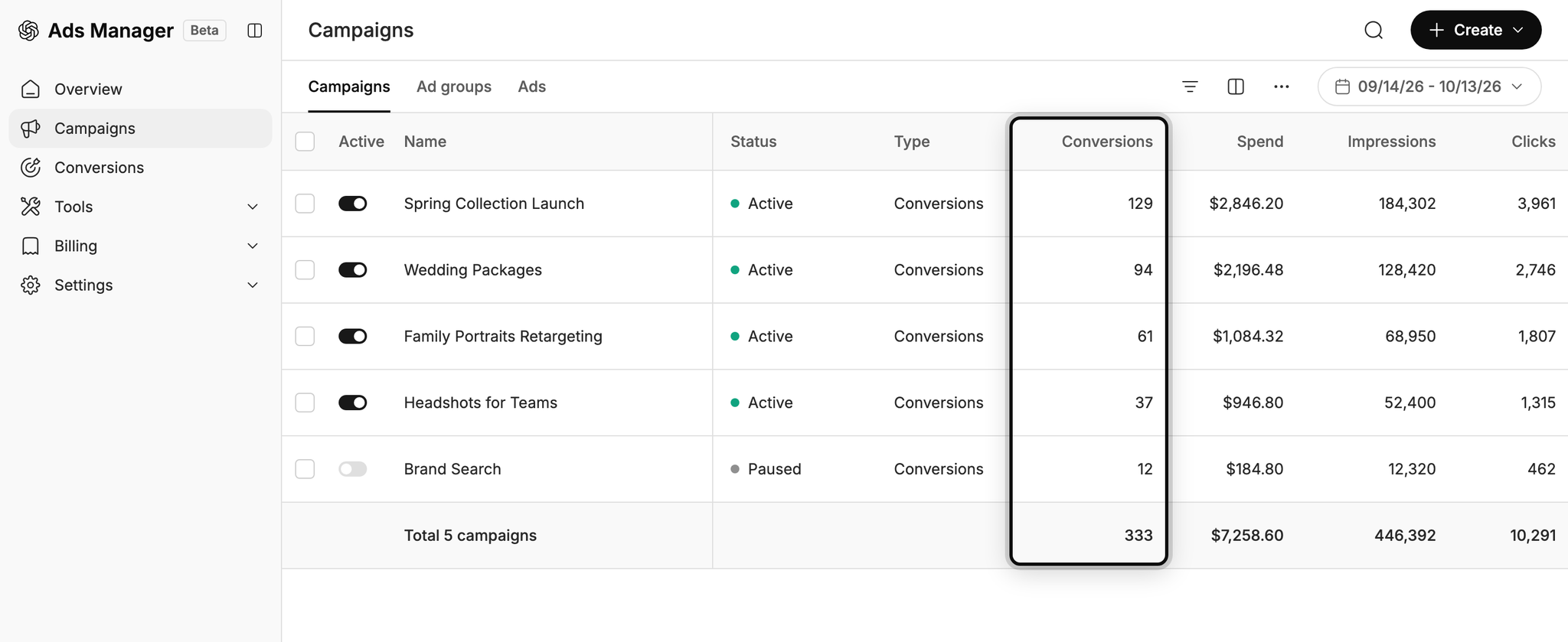
Without proper conversion tracking, all ChatGPT Ads can show you is impressions and clicks.
Once reliable conversion data comes in, you can see exactly how many leads each campaign and ad generates, how much you're paying for each one, and where the biggest growth opportunities are.
2. Let OpenAI's algorithm find you more of the right people
ChatGPT Ads uses advanced AI to decide who your ads are shown to and which conversations they appear in.
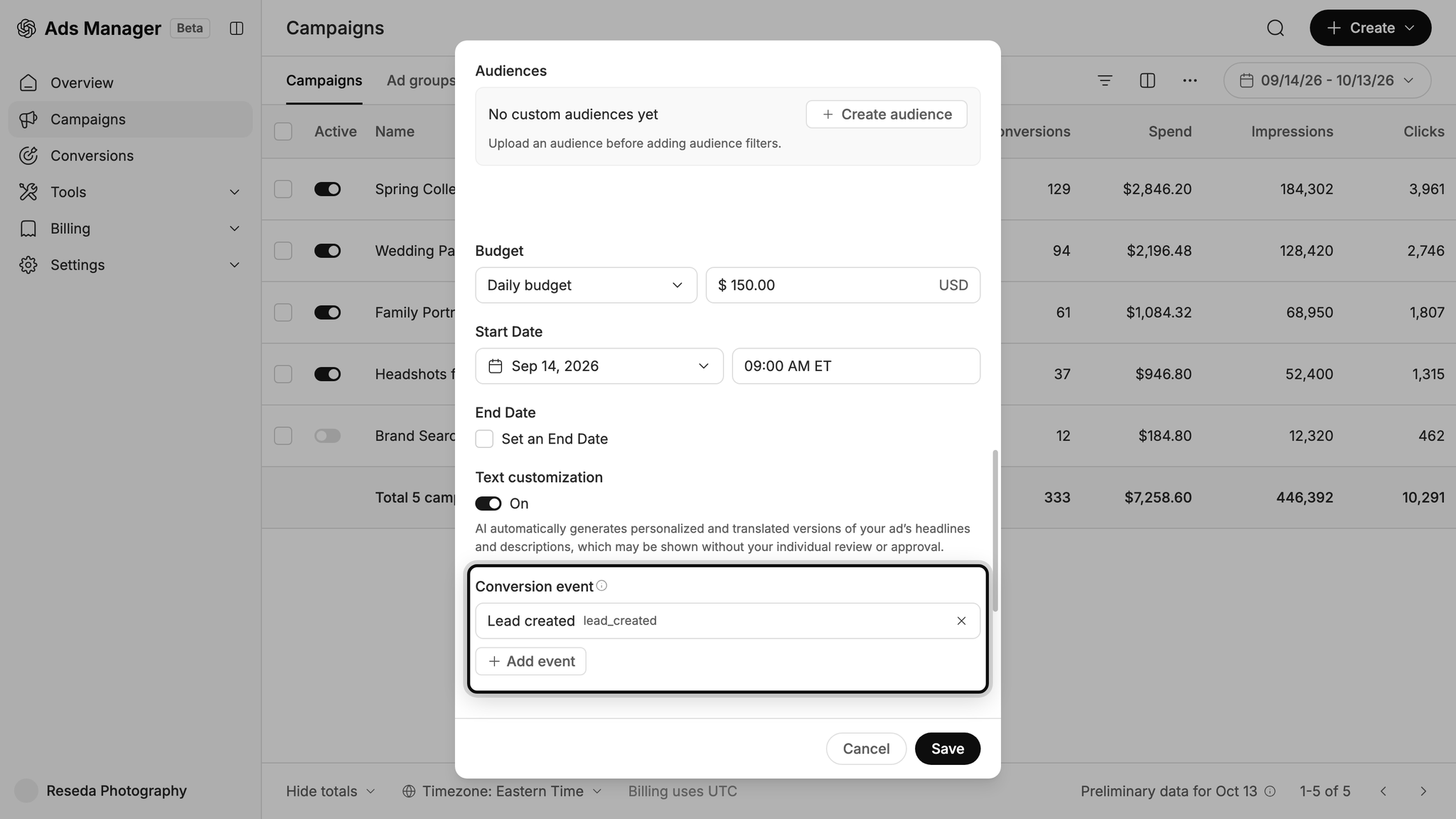
When your conversion tracking is set up properly, that AI gets the data it needs to understand what a great lead looks like for your business, and it will start putting your ads in front of more people just like them (which ultimately results in more qualified leads at a lower cost per lead).
Wrap Up
If you'd like ChatGPT Ads to get sent a conversion every time someone submits a Tally form on your website, Converly is the easiest (and best) way to do it.
Since it sends conversions directly to OpenAI's servers, ad blockers and privacy-focused browsers can't get in the way. And because it passes along every identifier OpenAI uses for matching (the click ID, name, email address and so on), each lead has the best possible chance of being connected to the ad that generated it.
Best of all, it only takes a few minutes to set up and there's a 14-day free trial (no credit card required), so start your free trial today!
About the author

Aaron is the founder of Converly. With over 15 years of experience in digital marketing and SaaS, he's passionate about helping businesses track and optimise their ad conversions.