


Track Marketo form submissions as conversions in Google Ads
Learn how to send server-side conversions to Google Ads whenever someone submits a Marketo form on your website. No code required!
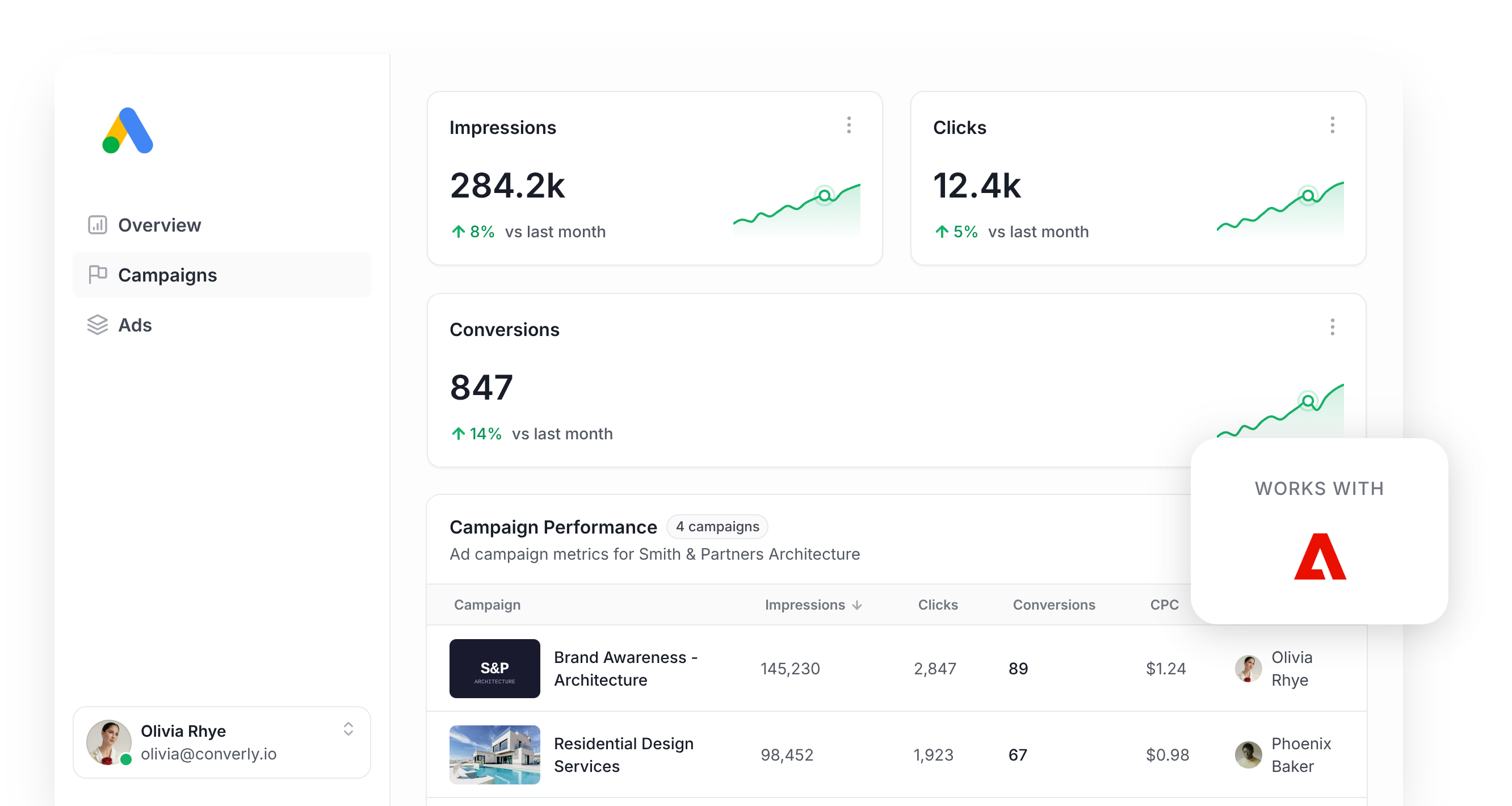
Google Ads is a great way to generate leads for your business, but how do you know it's actually working?
Most teams use tools like Google Tag Manager to send conversions, which means someone has to build out custom triggers, tags, and variables just to get a single conversion event flowing.
And relying on something simpler, like counting visits to a thank you page, isn't reliable. Thank you pages can be visited without submitting a form (they get indexed in Google, browser autocomplete sends people there, etc). And on top of all that, things like ad blockers and privacy restrictions in iOS and Safari can mean a third of your conversions don't make it through to Google.
So how do you fix it?
This guide walks through how to set up server-side conversion tracking in Google Ads when someone submits a Marketo form on your site.
Why you need to send conversions to Google Ads server-side
Accurate conversion data is the foundation everything else in Google Ads is built on.
Google Smart Bidding options (like Target CPA or Maximize Conversions) pull in thousands of signals (location, past purchases, interests, time of day, etc) to figure out how likely a given searcher is to convert into a lead, then adjust your bids up or down accordingly. But none of that works if Google can't tell which clicks actually turned into leads.
And that's where the issue lies. Doing things like tracking thank-you page visits in Google Tag Manager depends on specific bits of code loading in the visitor's browser, which opens the door to a few problems:
- Ad Blockers — When a visitor has an ad blocker running, the Google Tag simply never fires, so nothing gets recorded.
- Privacy Features in Browsers — Safari and similar browsers cap how long the Google Tag can track someone (often to just a day), so if a lead clicks your ad but doesn't convert until 3 days later then their conversion can't be tied back tot he original ad click.
- Using multiple devices — Someone might click your ad from their phone during lunch, then fill out your Marketo form when they are back at their computer, and there's no way for browser-based tracking to connect those two moments.
Server-side tracking is the answer to all of these problems. Rather than hoping that the Google Tag loads in the visitor's browser and that it can track what they did, you send the lead's details straight to Google's servers in a private request that ad blockers and privacy settings can't touch.
And it isn't just a theoretical improvement. Google reports that switching to server-side tracking drives a 23% average lift in recorded conversions, along with a 10% drop in cost per conversion, because the algorithm has good conversion data it can use to understand who your ideal customers are and serve your ads mre prominently to them.
3 simple steps to send server-side conversions to Google Ads from Marketo
Getting Marketo talking to Google Ads isn't actually that hard. Here's how to do it in 3 simple steps:
Step 1: Build your Conversion Flow in Converly
Converly is a tool that makes it easy to send server-side conversions to Google Ads when somebody submits a Marketo form on your website.
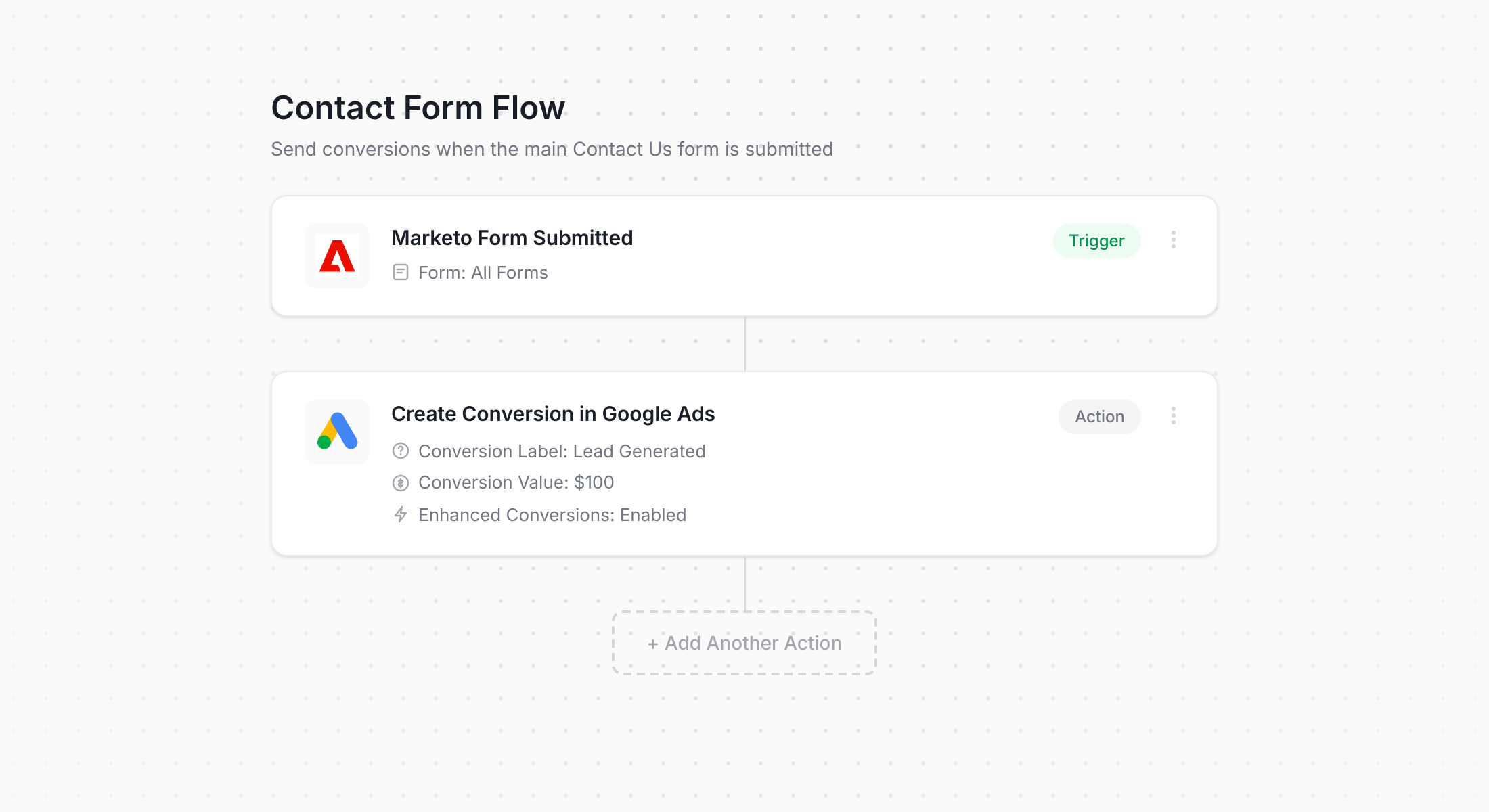
The screenshot above shows Converly's workflow builder in action, and if you've used tools like Zapier or Marketo's Smart Campaigns, the layout should be familiar to you.
You start by choosing your trigger, in this case a Marketo form being submitted, and then decide what should happen in response, like firing a conversion to Google Ads.
That's the entire setup. A handful of clicks and your server-side conversion tracking is set up.
Step 2: Add the Converly code to your website
After your Conversion Flow is built and published, Converly gives you a small snippet of code to add to your site.
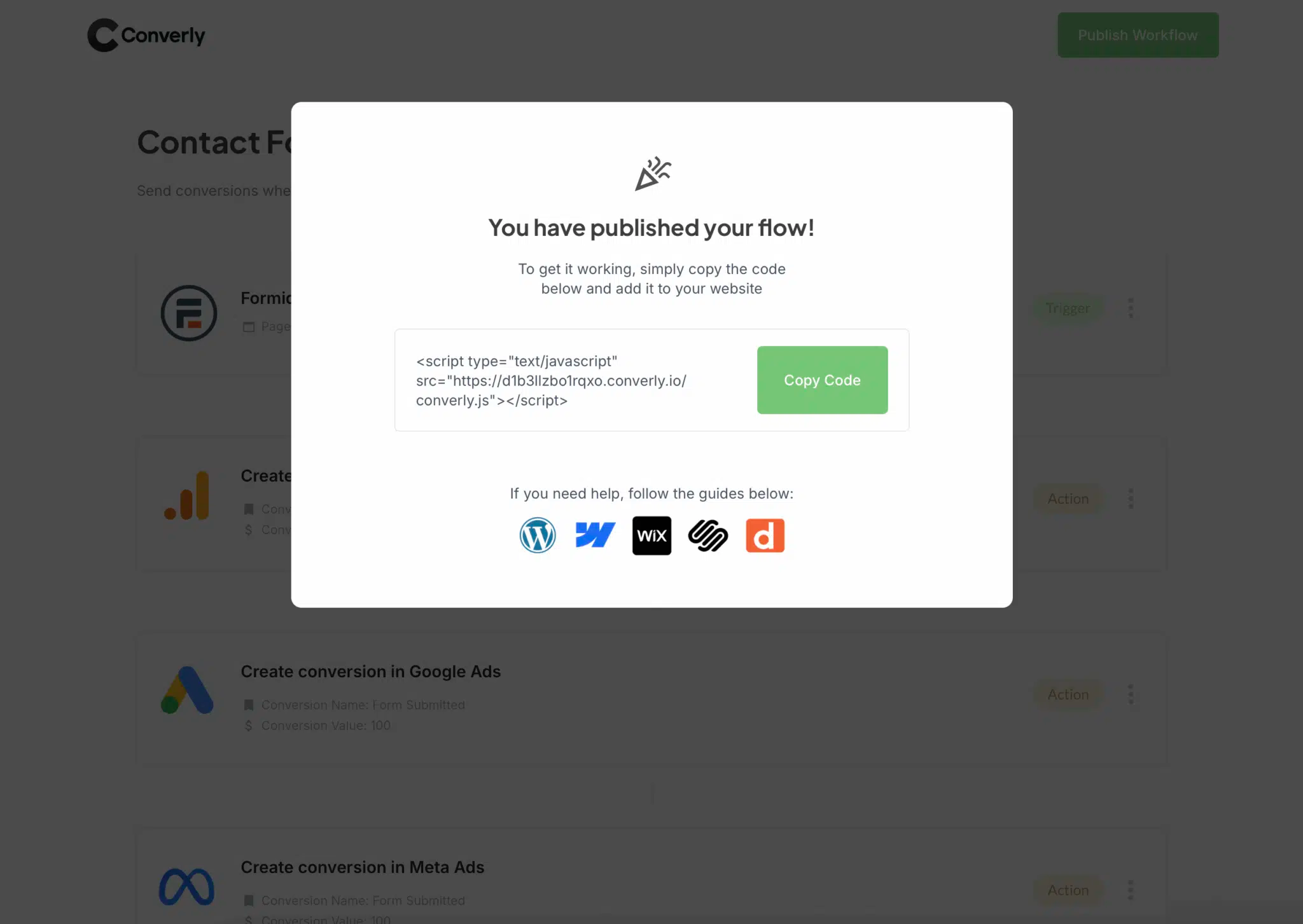
If your website runs on WordPress, Webflow, etc, you can usually just paste it into the Header or Custom Code section of your CMS, or install it via a header/footer plugin. You can also add it via Google Tag Manager as well, if that's how you manage the scripts on your website.
Step 3: Test it works
To confirm everything's wired up correctly, head to your live site and submit the Marketo form yourself.
Back in Converly, open your Conversion Flow, click the 3 dots menu in the top right corner, and choose View Logs.
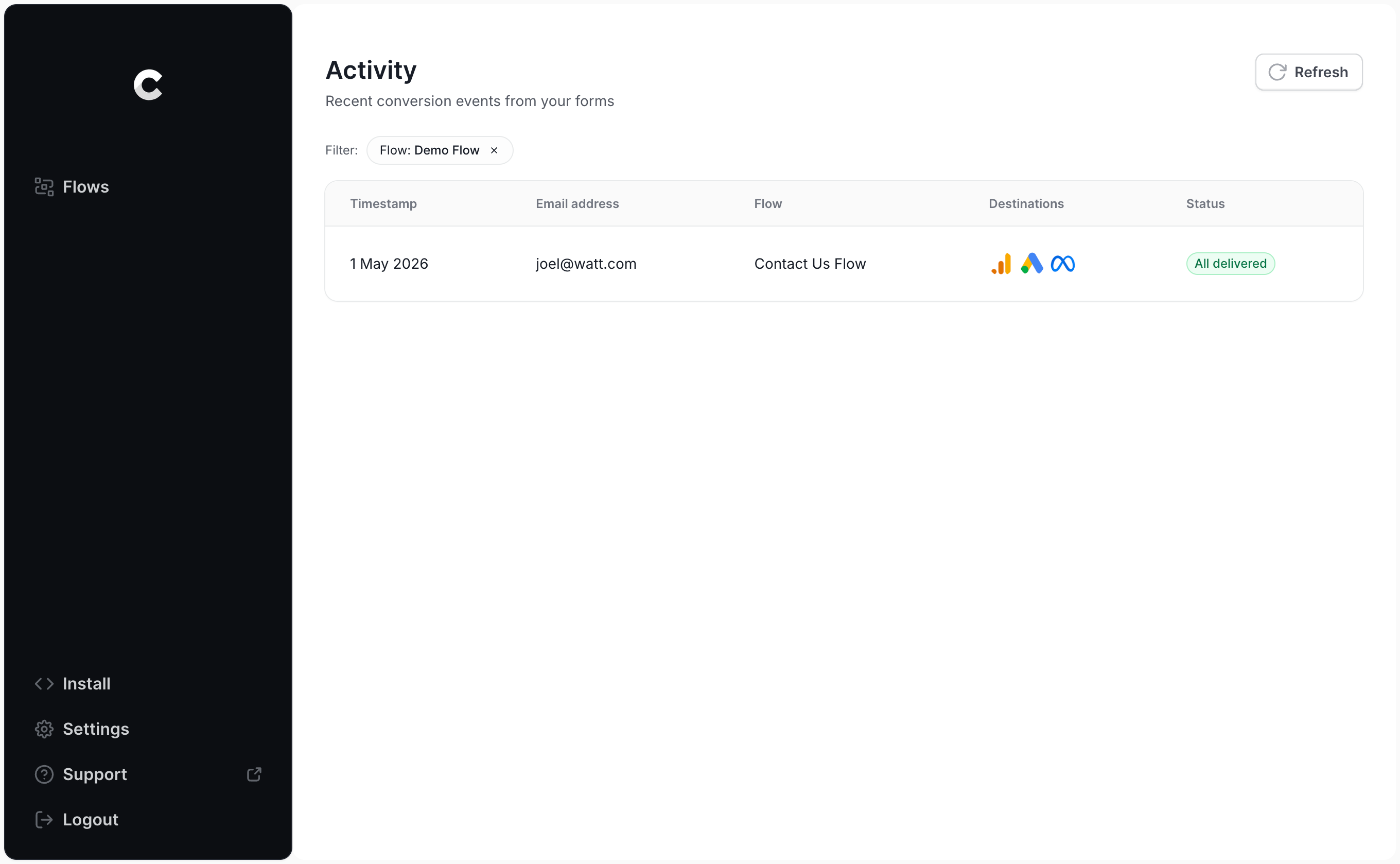
From the logs page, click into the entry from your test submission to see the full breakdown, including what data was captured about the lead and whether it made it to Google Ads successfully.
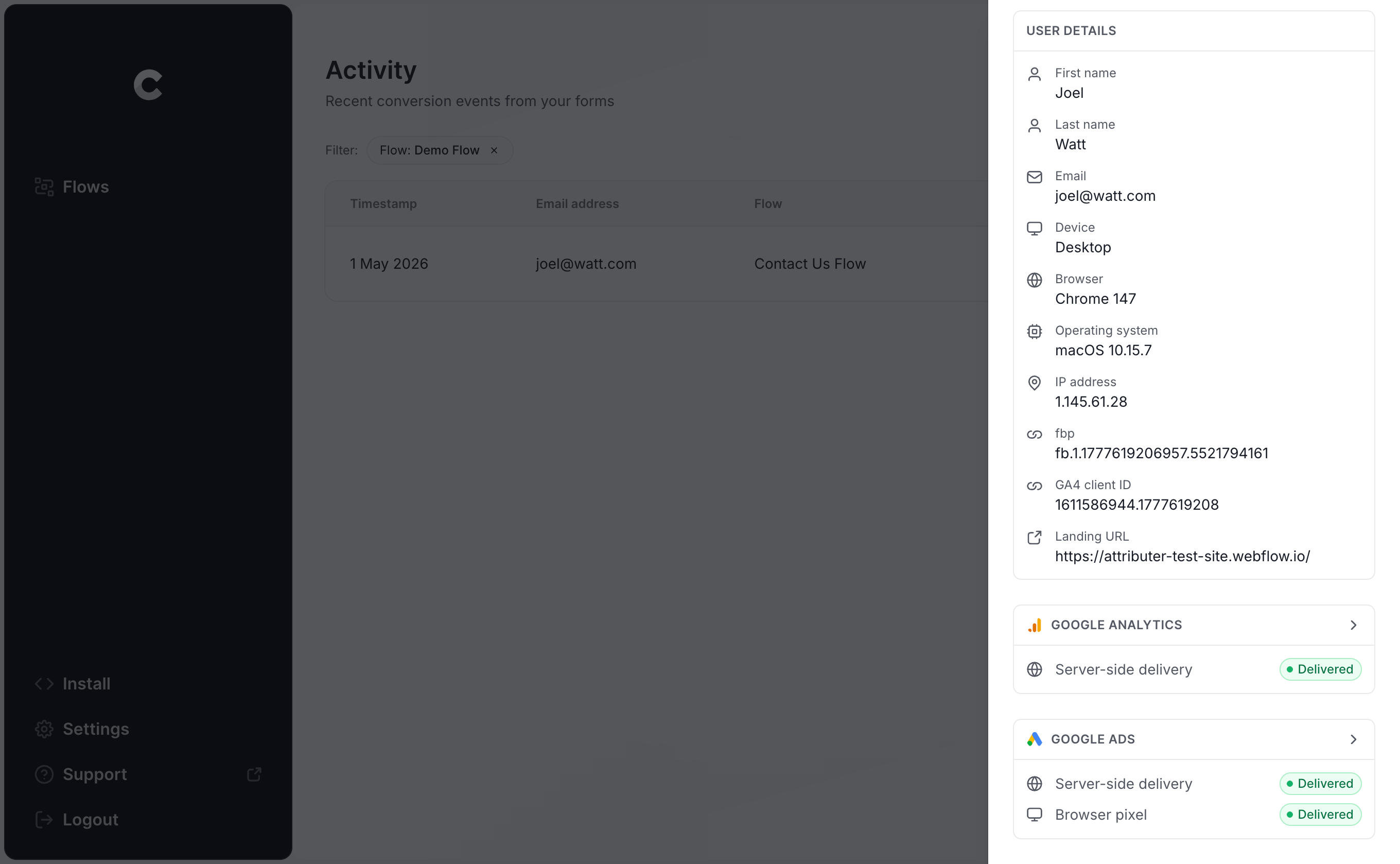
You can drill in even further to see exactly what data was passed over to Google Ads and how Google's servers responded.
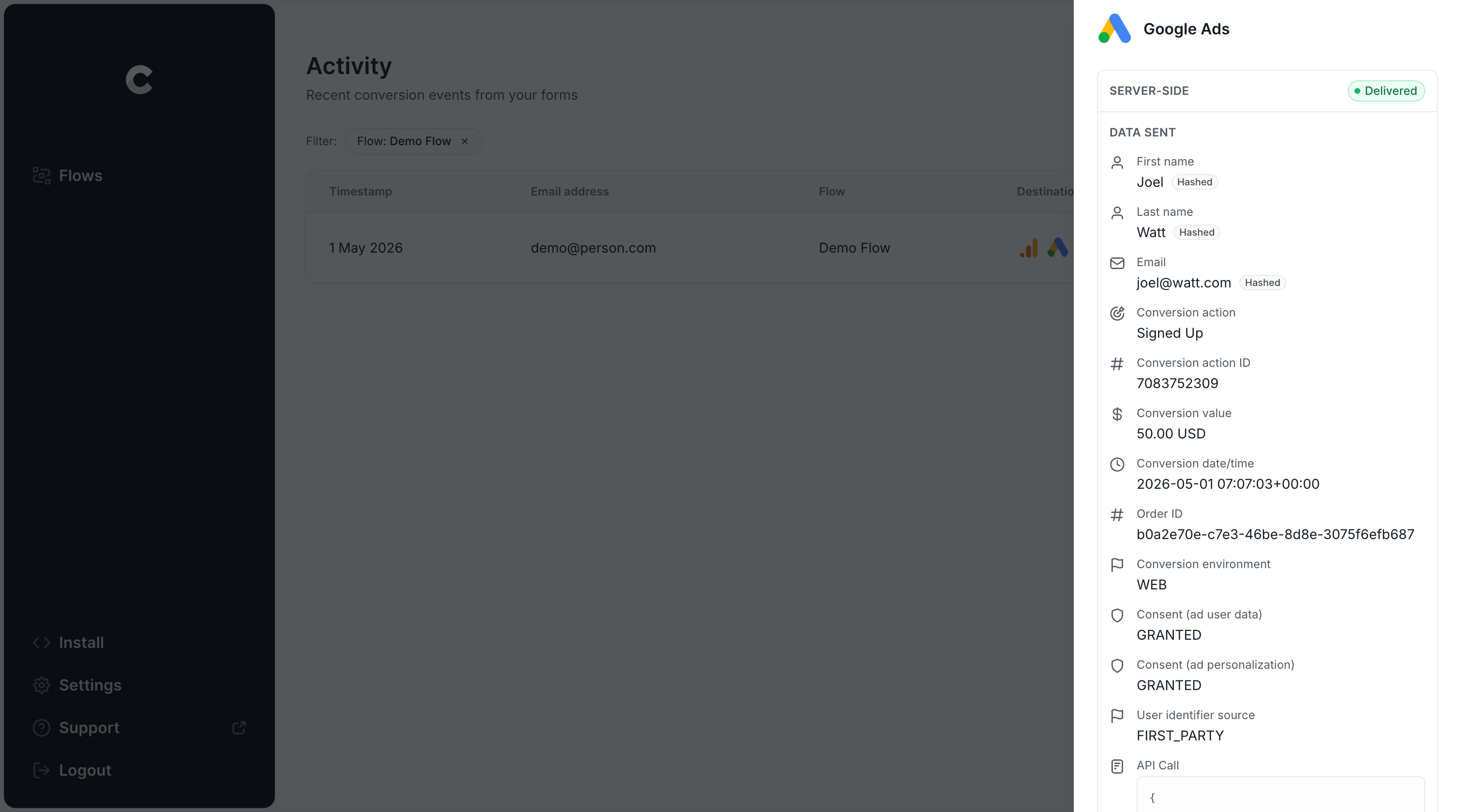
Once your test submission shows up in the log with a successful delivery to Google Ads, your tracking is good to go. The whole process typically takes less than 5 minutes.
Why Converly is the best way to send conversions to Google Ads from Marketo
There are other ways to send conversions to Google Ads from Marketo, so what makes Converly the best? Here are the main reasons.
1. Easy to set up
Most teams try to use Google Tag Manager for this, but that means writing custom code to listen for form submissions, pulling the lead's name and email into the DataLayer, hashing everything with SHA-256 (which Google requires), and then juggling variables, triggers, and tags on top of it all.
Unless someone on your team already knows Google Tag Manager and can write custom code, that's a lot of hours spent troubleshooting something that should be simple.
Converly makes it easy. Pick your trigger (a Marketo form submission), pick your action (a Google Ads conversion), and you're done. No custom code and no complicated configuration to maintain.
2. Not affected by ad blockers and privacy restrictions
Relying on Google Tag Manager, or on something even simpler like thank you page tracking, means a meaningful chunk of your conversions never actually make it back to Google Ads (thanks to ad blockers and privacy-focused browsers stopping the Google Tag from loading in the visitor's browser).
In fact, one study looking at over 7 million conversions found that tag-based tracking missed roughly 30% of conversions.
Converly avoids that entire problem by sending conversions directly to Google's servers, so ad blockers and privacy browsers can't interfere.
3. Works across devices
It's common for someone to first click your ad on one device (their phone for instance), then circle back later on another device (like their work computer) to actually fill out the form.
Tools that rely purely on tracking things that happen in the browser (like Google Tag Manager) can't bridge that gap, since the two things happened on different devices.
Converly gets around this by sending the lead's details (name, email, phone, etc.) directly to Google's servers, which gives Google the data it needs to connect the eventual conversion back to whichever ad click started the journey (no matter what device it happened on).
4. Sends more data
Beyond sending the lead's basic contact details, Converly also captures technical signals like the Google Click ID (GCLID), IP address, and User Agent, and passes all of it along to Google Ads with each conversion.
That extra context gives Google Ads a much better chance at matching a conversion back to the original ad click, even if weeks between the two events.
For you, that translates into more reliable conversion tracking (and ultimately more leads at a lower cost per lead, because Google Ads has the data it needs to understand who your ideal customers are and serve your ads more prominently to people like them).
5. Supports multiple tools and platforms
Converly isn't limited to Marketo. It connects with over 100 form builders, scheduling tools, chat widgets, and other website tools.
And on the delivery side, it can send conversion events to Google Analytics, Google Ads, Meta Ads, LinkedIn Ads, ChatGPT Ads, Microsoft Ads, and a range of other platforms.
That means if you add a new tool to your website, or you start running ads on a new platform, you're not starting your tracking setup from zero. It's just a few clicks inside Converly to get connected.
6. Gives you a full conversion log and email alerts
With something like Google Tag Manager, once it's set up you're essentially flying blind. You might run a few tests at launch, but without repeating them regularly, there's no way to know if a form field got renamed, a tag got edited, or something in Google Ads quietly broke your setup.
Converly removes that guesswork entirely. Every conversion that fires shows up in a full log, along with exactly what data was captured, what got sent to Google Ads, and how Google responded.
You can also switch on email alerts, either for every conversion or just for failed ones, so you find out as soon as something stops working (instead of weeks later when you just see 0 conversions in your Google Ads account).
3 things you can do when you properly send conversions to Google Ads from Marketo
Once you've got real, accurate conversion data flowing into Google Ads, there's a whole bunch of things you can do that you couldn't before.
1. Report on conversions by campaign, ad group, keyword, etc.
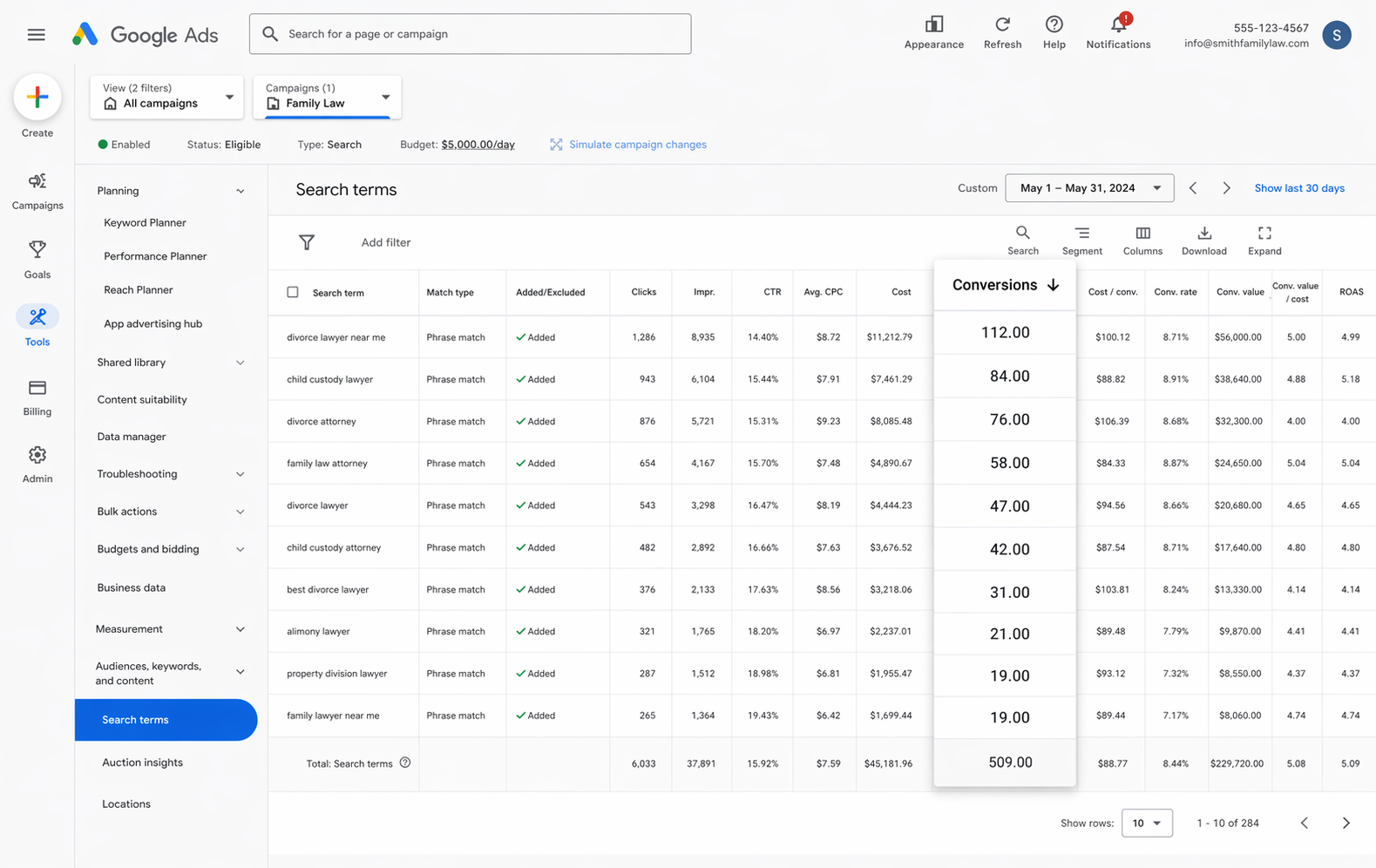
With accurate tracking in place, your Google Ads account shows a lot more than clicks and impressions. You get conversion counts, conversion rate, cost per conversion, return on ad spend, and more.
You can slice all of that by campaign, ad group, keyword, ad, country, and other dimensions.
That level of detail makes it much easier to see how your campaigns are actually performing, which ones to invest more in, and which ones to let go of.
2. Use Google's Smart Bidding technology
With Manual bidding, you're basically telling Google "spend up to $3 per click" and it does that regardless of who the searcher is and how likely they are to actually convert into a lead.
Smart bidding flips that around. You give Google a target, like $45 per lead, and it handles everything else for you automatically. It factors in everything it knows about the searcher (age, location, device, interests, past purchases, etc) and decides whether to bid higher or lower, based on how likely that person is to convert.
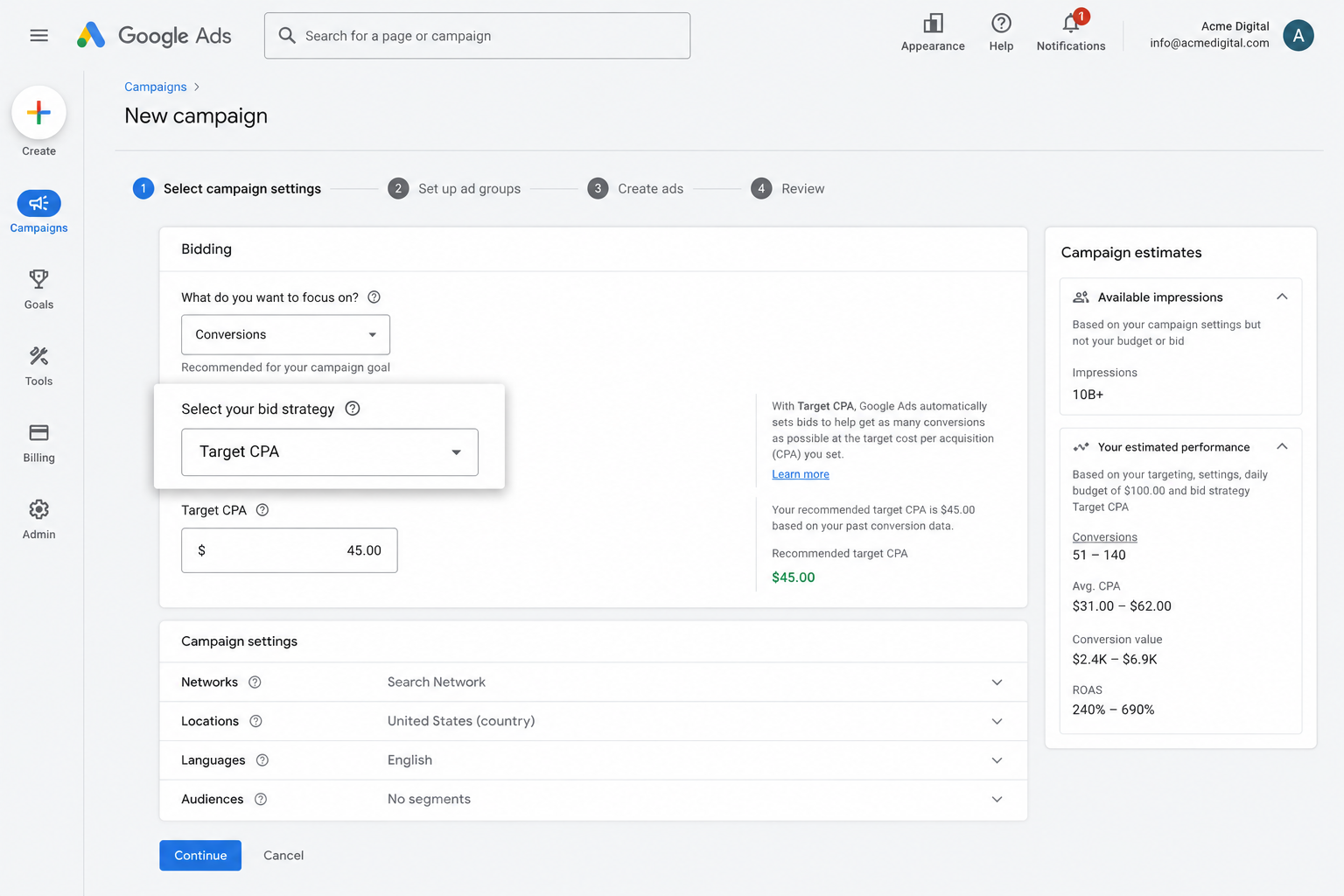
That only works, though, if the conversion data feeding it is accurate. Without it, Google has no idea of what a "good" visitor looks like for your business, and ends up overpaying for clicks from people who were never going to convert.
So setting up accurate, server-side conversion tracking with Converly means Google's smart bidding actually has something useful to work with, which typically means you get more leads for less spend.
3. Retarget people who visited your site but didn't convert
Once accurate conversion data is flowing into Google Ads, you can build remarketing lists made up of visitors who showed up but didn't convert.
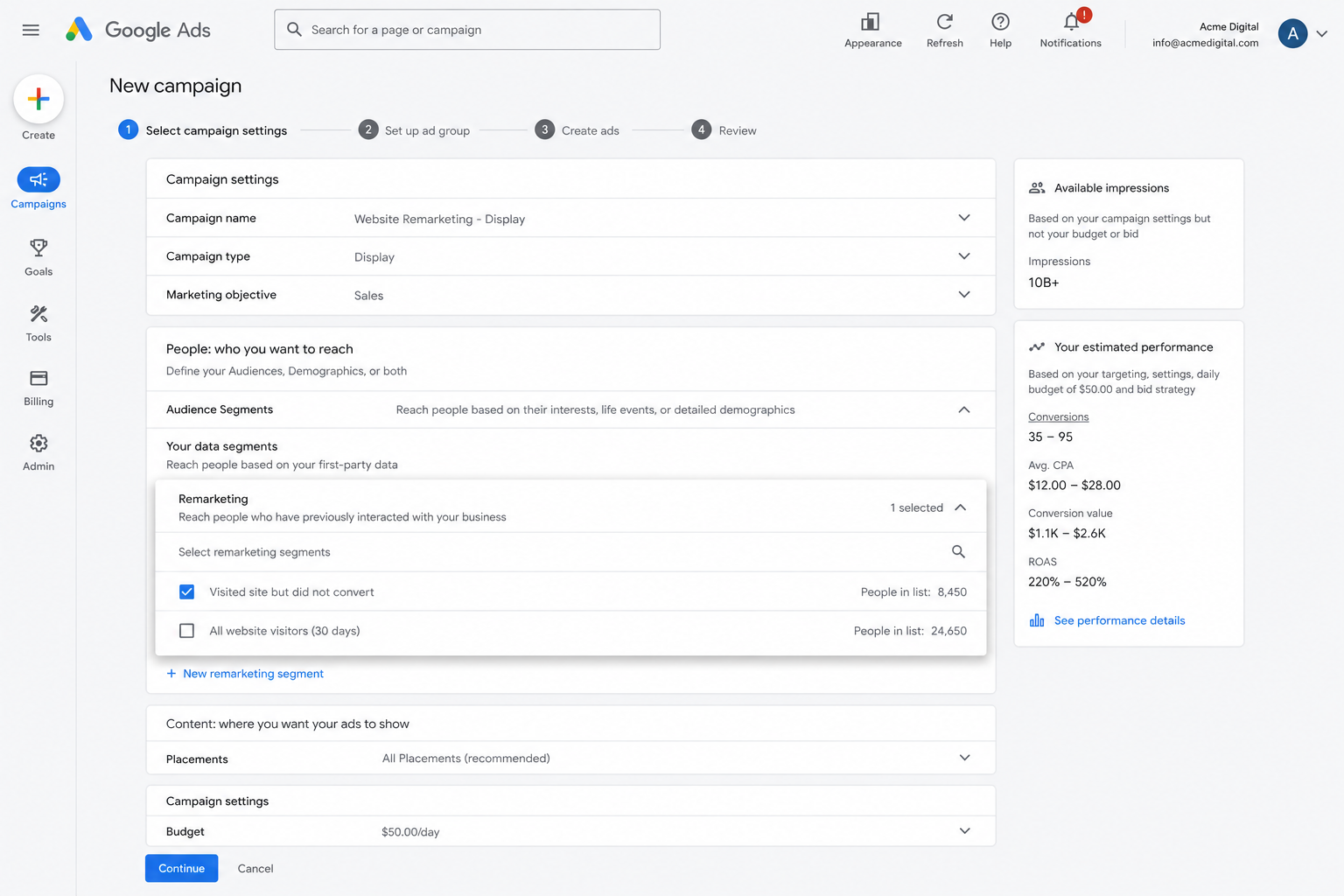
From there, you have several ways to bring those people back:
- Search — Adjust your bids up (or down) specifically for these people the next time they search your keywords.
- Display — Run banner ads across the Google Display Network aimed just at this audience, keeping your brand visible as they browse other sites.
- YouTube — Serve YouTube ads to this same group so they keep seeing your business while watching video content.
Wrap Up
If Marketo powers the forms on your site and you want those submissions sent back to Google Ads as conversions, then Converly is a solid way to get there.
It sends conversions straight to Google's servers so ad blockers and privacy browsers can't get in the way, and it gives Google a heap of lead data (name, email, phone, IP address, User Agent, and more) so Google has the best possible shot at tying the conversion back to the original ad click.
It only takes a few minutes to set up, and it comes with a 14-day free trial, so give it a try today!
About the author

Aaron is the founder of Converly. With over 15 years of experience in digital marketing and SaaS, he's passionate about helping businesses track and optimise their ad conversions.