


Track Framer form submissions as conversions in ChatGPT Ads
Learn the best way to send a conversion to ChatGPT Ads when a visitor submits a form on your Framer website. No code required!
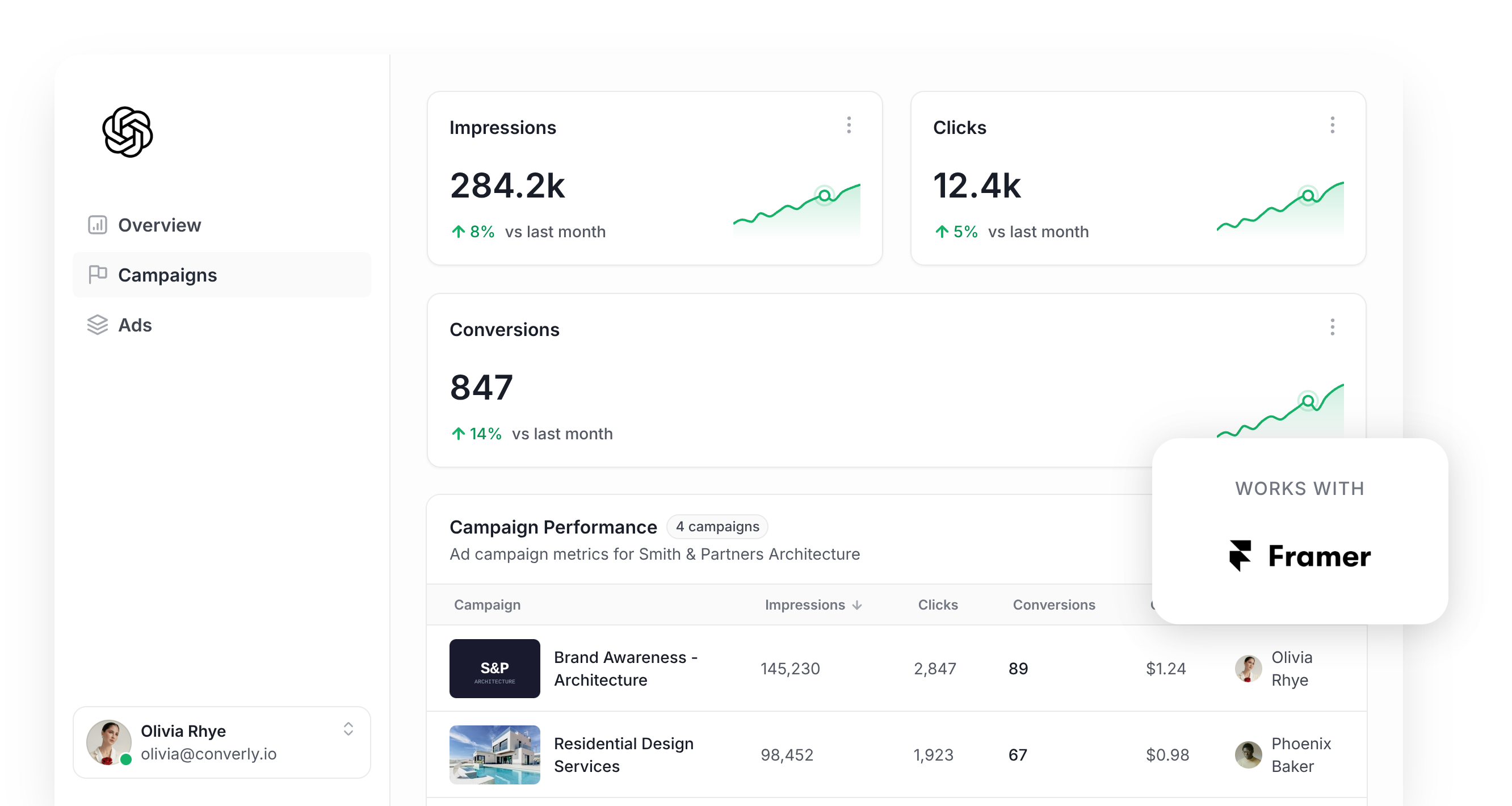
Are you about to start running ChatGPT Ads to bring in more leads for your business?
If so, then there's one thing you really need to nail before you spend a dollar, and that's conversion tracking.
That's because ChatGPT Ads, like pretty much every ad platform out there today, uses AI to figure out which people are most likely to become leads and then serve your ads to those people.
There's a catch though. That AI is only as smart as the conversion data you feed it. If ChatGPT Ads can't see which ad clicks turned into real leads, it has no idea who it should be targeting, so it happily spends your budget on people who were never going to fill in your form.
This matters even more with ChatGPT Ads too, because there are no keywords for you to choose. You're relying on ChatGPT to slot your ad into conversations it thinks are relevant, and unless proper conversion data is coming back, it can't tell which of those conversations are producing leads and which ones aren't.
So how do you set up accurate conversion tracking in ChatGPT Ads?
In this article, we'll walk you through the best way to send a conversion to ChatGPT Ads whenever someone submits a form on your Framer site.
What proper conversion tracking looks like in ChatGPT Ads
Getting conversion tracking right in ChatGPT Ads boils down to 2 things. First, every single conversion needs to actually reach ChatGPT Ads. Second, each of those conversions needs to carry enough information for ChatGPT Ads to link it to a real person and to the ad they originally clicked.
Let's break it down:
Getting every conversion delivered
The problem with just installing the ChatGPT Measurement Pixel on your site is that it relies on the visitor's browser to pass the conversion along, and ad blockers and built-in privacy protections stop that from happening all the time.
How much are we talking? Industry research suggests 30% or more of conversions go missing this way. So if you took this approach, your reports would drastically undercount the amount of leads you're getting, and ChatGPT's algorithm would get a lot less data to learn from when it's deciding who should see your ads next.
For that reason, OpenAI recommends sending every conversion via 2 separate routes. One goes through the visitor's browser using the Measurement Pixel, and the other goes from a server straight to OpenAI using the Conversions API (which is what people are referring to when they talk about "server-side tracking"). The idea is that, if the pixel gets blocked in someone's browser, the server-side conversion is still there as a safety net.
Making sure each conversion can be matched
Delivering the conversion is only part of the job. When it lands in ChatGPT Ads, the platform still needs to match it back to an actual person and to the exact ad that person clicked (and when it can't do that, the conversion simply doesn't count). Unfortunately, there are a few things that make this matching a lot trickier than you'd think:
- Browser privacy features - Privacy-focused browsers like Safari only keep tracking cookies for a short window (often 7 days or less). So if a visitor clicks your ad on a Monday and comes back to fill in your Framer form 10 days later, the cookie tying them back to the original ad click is long gone.
- Switching devices - Plenty of people click an ad on their phone and then return days later on a laptop or desktop to actually submit the form. Since the click and the submission happen on separate devices, there's no cookie to link them together.
- Switching browsers - A huge number of people use the ChatGPT app on their phone. When they tap your ad and open your site in the in-app browser, the cookies get set in that browser (completely separate from their regular browser like Safari or Chrome). So if they later come back in their regular browser and submit your form, the original cookie isn't available and can't be used to tie the conversion back to the original ad click.
The way around all 3 problems is to send extra details about the lead with each conversion. That means their name, email address and phone number, plus the Click ID (in ChatGPT Ads this is called the oppref), IP address and User Agent. ChatGPT Ads then uses this data to match the conversion back to a real ChatGPT user, and subsequently to the ad they originally clicked.
3 simple steps to send proper, server-side conversions to ChatGPT Ads from Framer
Now you know what good conversion tracking in ChatGPT Ads looks like, here's the simplest way to get it running on your Framer site.
Step 1: Build your Conversion Flow in Converly
Converly is a conversion tracking tool that makes it easy to send proper, server-side conversions to ChatGPT Ads whenever someone submits a Framer form on your site.
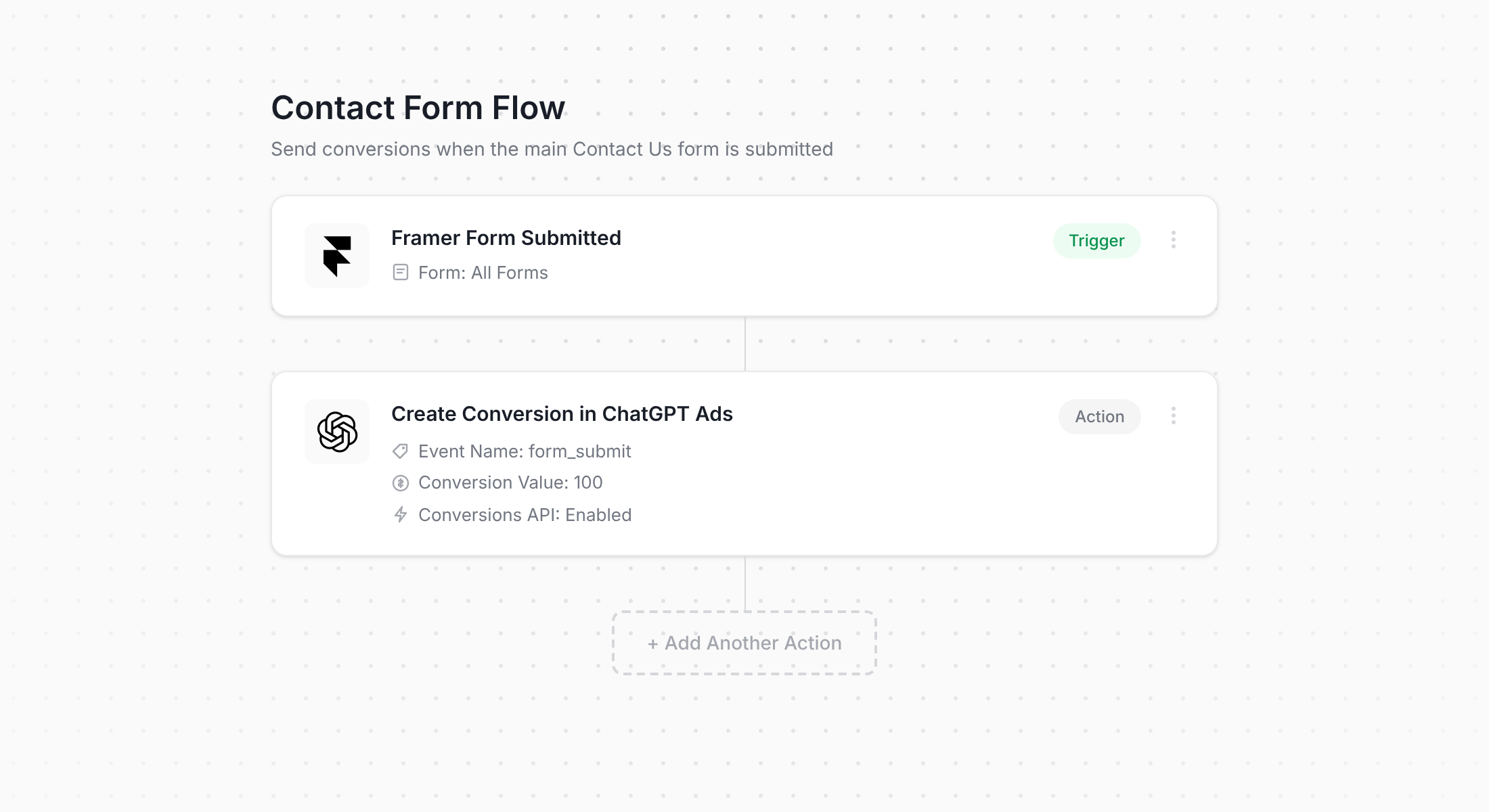
What you're looking at above is the Converly flow builder. If you've ever put together a Zap in Zapier or built an automation in an email marketing tool, you'll recognize how it works.
You start by picking a trigger (in this case, a visitor submitting a Framer form on your site), and then you pick what should happen next (like a conversion being sent to ChatGPT Ads). Honestly, that's all there is to it. A few clicks later and server-side conversion tracking for ChatGPT Ads is up and running.
And if you're using an AI assistant like Claude or ChatGPT, then it's even easier. Just install the Converly plugin, ask it to 'Set up ChatGPT Ads conversion tracking for my Framer forms', and it will build the whole thing for you!
Step 2: Add the Converly code to your website
After you've built and published your Conversion Flow, Converly gives you a small code snippet to add to your website.
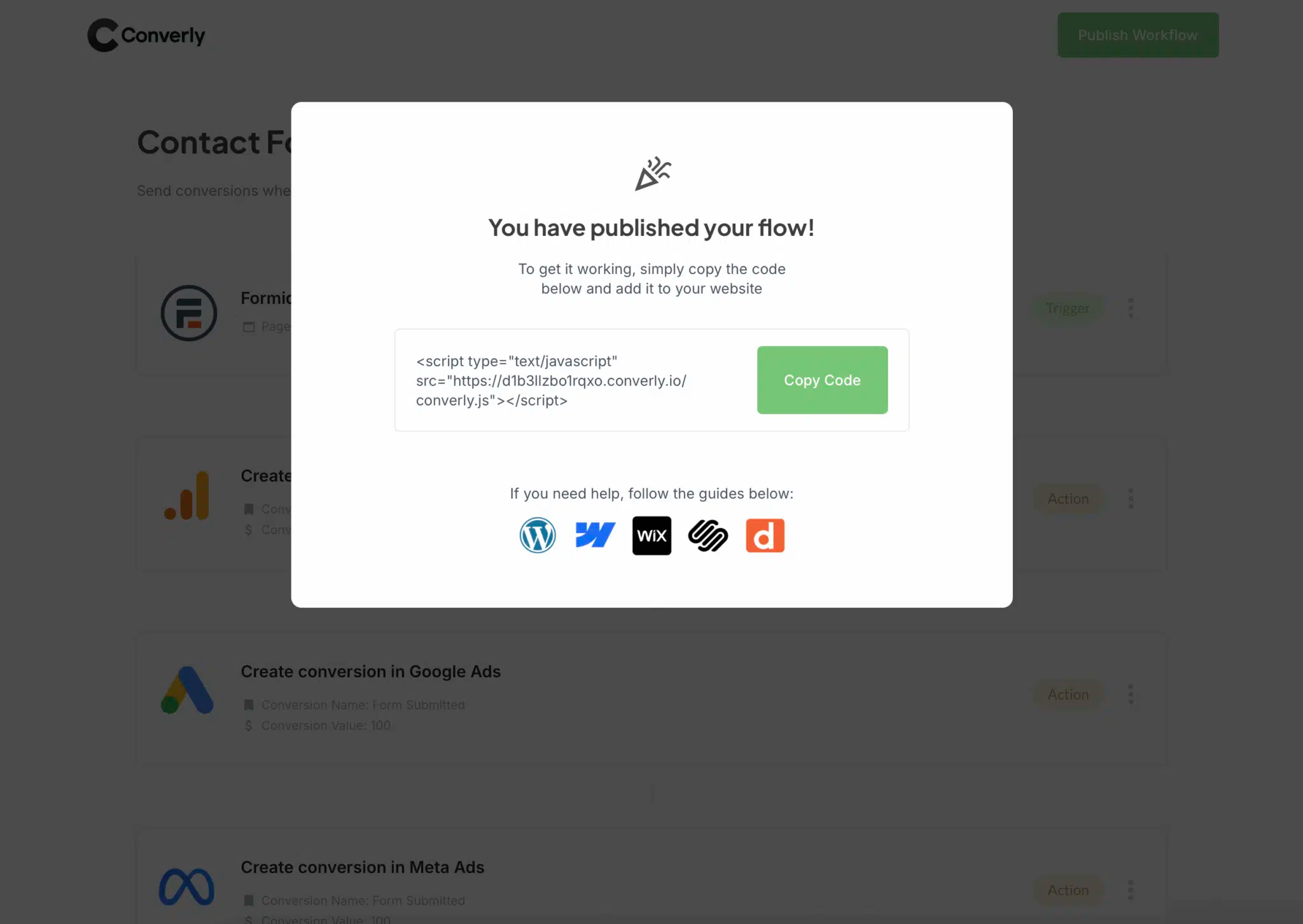
In Framer, open your project, head to Site Settings and scroll down to the Custom Code section. Paste the snippet into the "Start of <head> tag" box so it loads on every page, then hit Publish so the change goes live on your site.
Or if you already manage all your scripts through Google Tag Manager, you can add it there instead.
Step 3: Test it works
Now it's time to check everything is working. Go to your live Framer site and submit one of your forms yourself.
Then jump back into Converly and click 'Logs' in the main navigation.
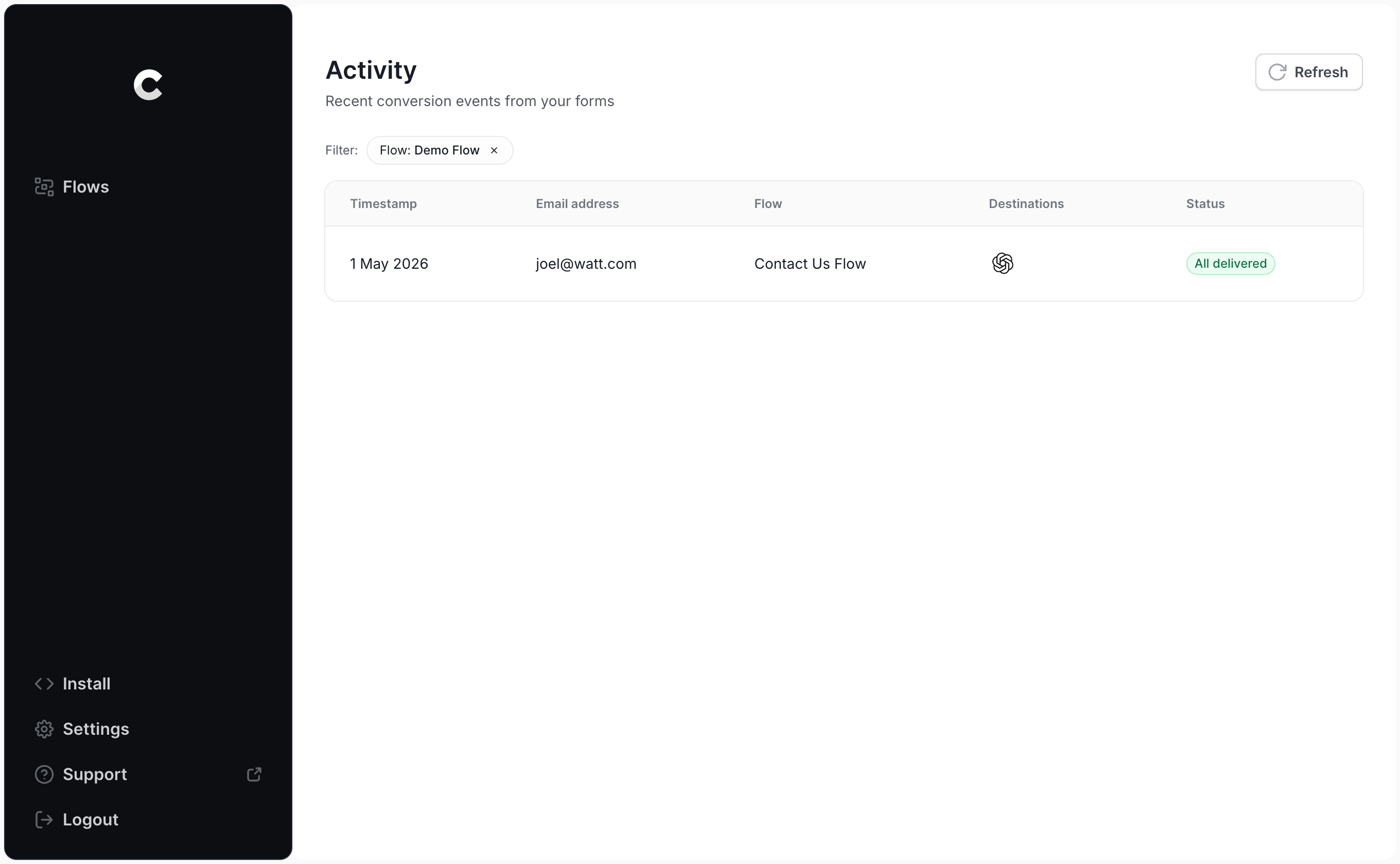
Find your test submission in the list and click on it. This shows you all the information Converly collected about the submission, plus whether the conversion was delivered to ChatGPT Ads.
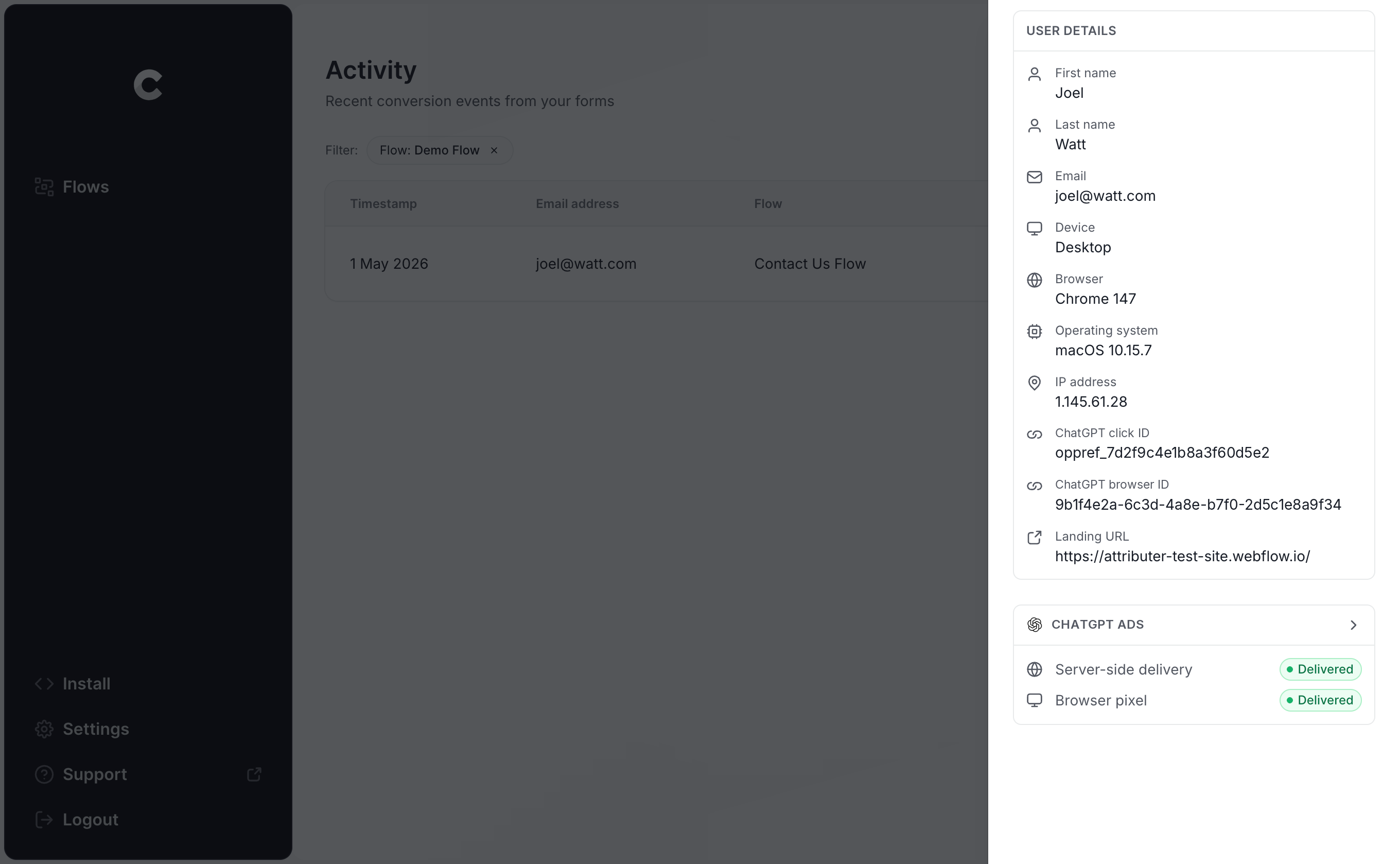
If you want to dig deeper, you can open up the exact payload Converly sent to ChatGPT Ads (including the click ID, browser ID and hashed email address) along with the response OpenAI's server sent back.
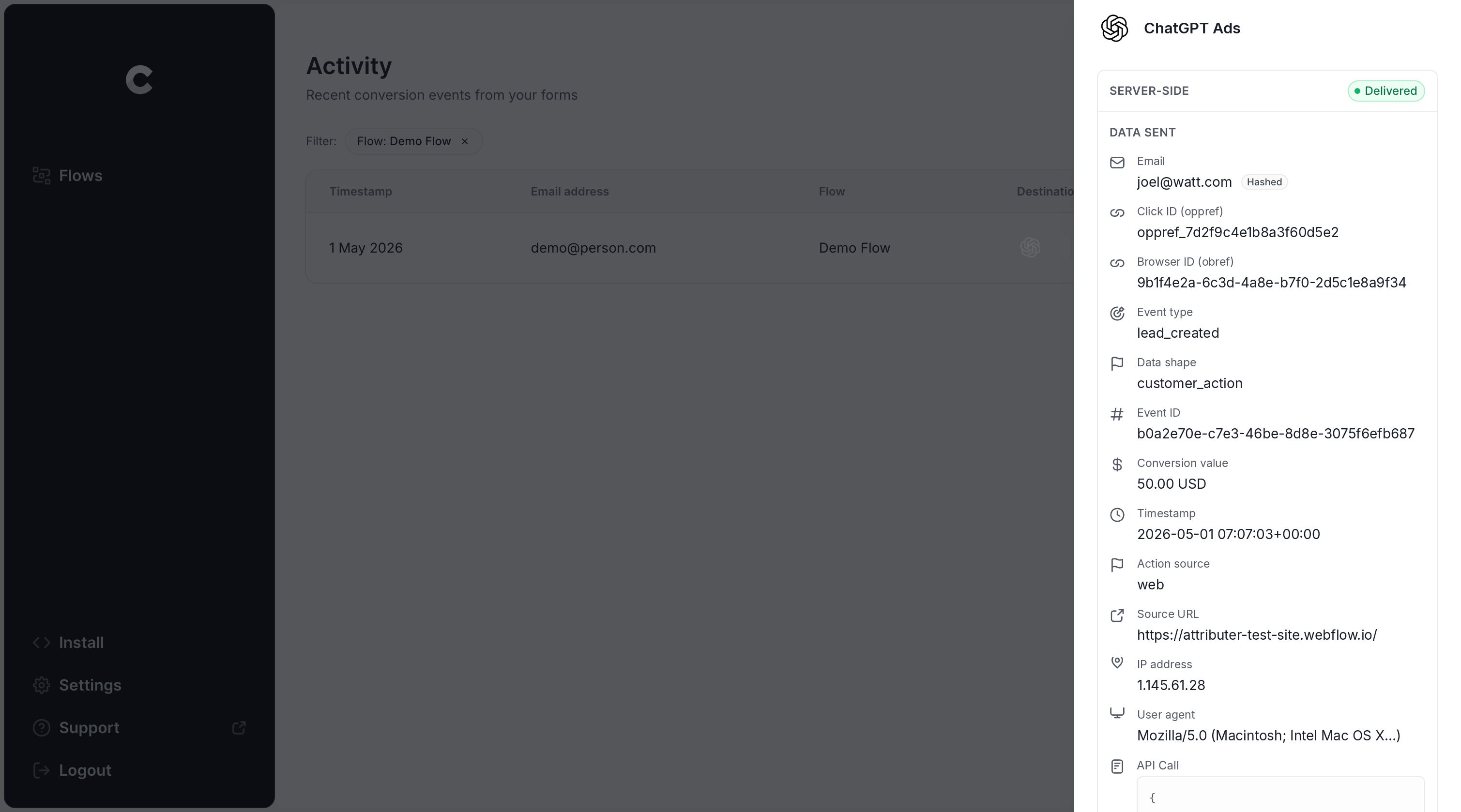
Once your test submission appears in the log and it shows it was successfully sent to ChatGPT Ads, your conversion tracking is live. Most people finish the whole setup in less than 5 minutes.
Why Converly is the best way to send conversions to ChatGPT Ads from Framer
There are a few different ways to get a conversion into ChatGPT Ads when someone completes a Framer form, so why use Converly? Here's what makes it different:
1. Easy to set up
Doing all of this yourself would be a real pain. You'd have to write code that listens for Framer form submissions, grabs the click ID and browser cookie, extracts the lead's name, email and phone number from the form, hashes it with SHA-256, and sends it over to ChatGPT Ads (formatted exactly how OpenAI expects it). You'd also need to build systems to handle API keys, manage deduplication and retries, secure the personal information, and more.
But with Converly, none of that is your problem. You simply choose a trigger (a Framer form submission), choose an action (a conversion sent to ChatGPT Ads), and Converly takes care of everything else. There's no custom code to write and no API keys to manage, just conversion tracking that works.
And if you already work with an AI tool like Claude or ChatGPT, simply install the Converly plugin, ask it to 'Set up ChatGPT Ads tracking for my Framer forms', and it will handle the whole setup for you!
2. Not affected by ad blockers and privacy restrictions
When you rely only on the ChatGPT Ads Measurement Pixel (without also sending conversions server-side through the Conversions API), a big chunk of your conversions will never reach OpenAI at all, because ad blockers and privacy-focused browsers stop the pixel from loading in the first place.
So how big is that chunk? One study covering more than 7 million conversions found browser-based tracking missed roughly 30% of them. In other words, almost a third of your conversions would simply go uncounted.
Converly sends every conversion via both routes (through the browser to the ChatGPT Measurement Pixel, and server-side to the Conversions API), so your conversions keep making it back to ChatGPT Ads no matter what ad blocker or privacy settings your visitors are using.
3. Works across devices
It's really common for a lead to find your website on one device (like scrolling on their phone during a lunch break) and then fill out your Framer form later on their computer.
If you're just using the ChatGPT Measurement Pixel, there's no way to connect that conversion back to the original ad click, because the click and the submission happened in different browsers on different devices.
Converly solves this by capturing the click ID (the oppref) and sending it to ChatGPT Ads together with the lead's name, email address and phone number. That gives ChatGPT Ads everything it needs to match the conversion to a real person and the ad they clicked, even when that click happened on another device weeks earlier.
4. Sends more data
As soon as a visitor arrives on your Framer site, Converly captures the ChatGPT click ID, the browser cookie set by the ChatGPT Ads pixel, and the visitor's user agent, and saves them. Then, when that person submits a form, Converly extracts the name, email and phone number from the form and sends everything over to ChatGPT Ads with the conversion.
This gives ChatGPT Ads all the data it needs to connect each conversion back to a real person and the ad they clicked, which means all your conversions get counted (not just some of them) and you end up with conversion numbers you can actually rely on.
5. Supports multiple tools and platforms
Converly can detect conversions in more than 100 form builders, scheduling tools, chat widgets, and more. And on the other side, it can send conversions to ChatGPT Ads, Google Ads, Meta Ads, LinkedIn Ads, Microsoft Ads, Google Analytics and lots of other platforms.
So if you're running Google Ads or Meta Ads alongside ChatGPT Ads, there's no need to build a separate setup for each one. You just add them as extra actions in your Conversion Flow, and every Framer form submission gets sent to all of them at the same time. And if you decide to try advertising on a new platform, it's a matter of a few clicks to get that set up too.
6. Gives you a full conversion log and email alerts
Most other ways of setting up conversion tracking (like Google Tag Manager) can't tell you whether things are working or not.
You might test it on the day you set it up, but if someone later rebuilds the form in Framer, changes the success message to a redirect, or tweaks something in ChatGPT Ads Manager, your tracking can break without anyone noticing.
Converly removes that uncertainty. You get a complete conversion log listing every conversion from your Framer forms, the data that was captured, exactly what was sent to ChatGPT Ads, and whether it was accepted or not.
You can also switch on email notifications (for all conversions, or just for failures) so if something ever does go wrong, you'll find out about it right away.
2 things you can do when you properly send conversions to ChatGPT Ads from Framer
Once accurate conversion data is flowing from your Framer forms into ChatGPT Ads, you unlock a couple of things that just aren't possible when you're working in the dark.
1. See which campaigns and ads actually produce leads
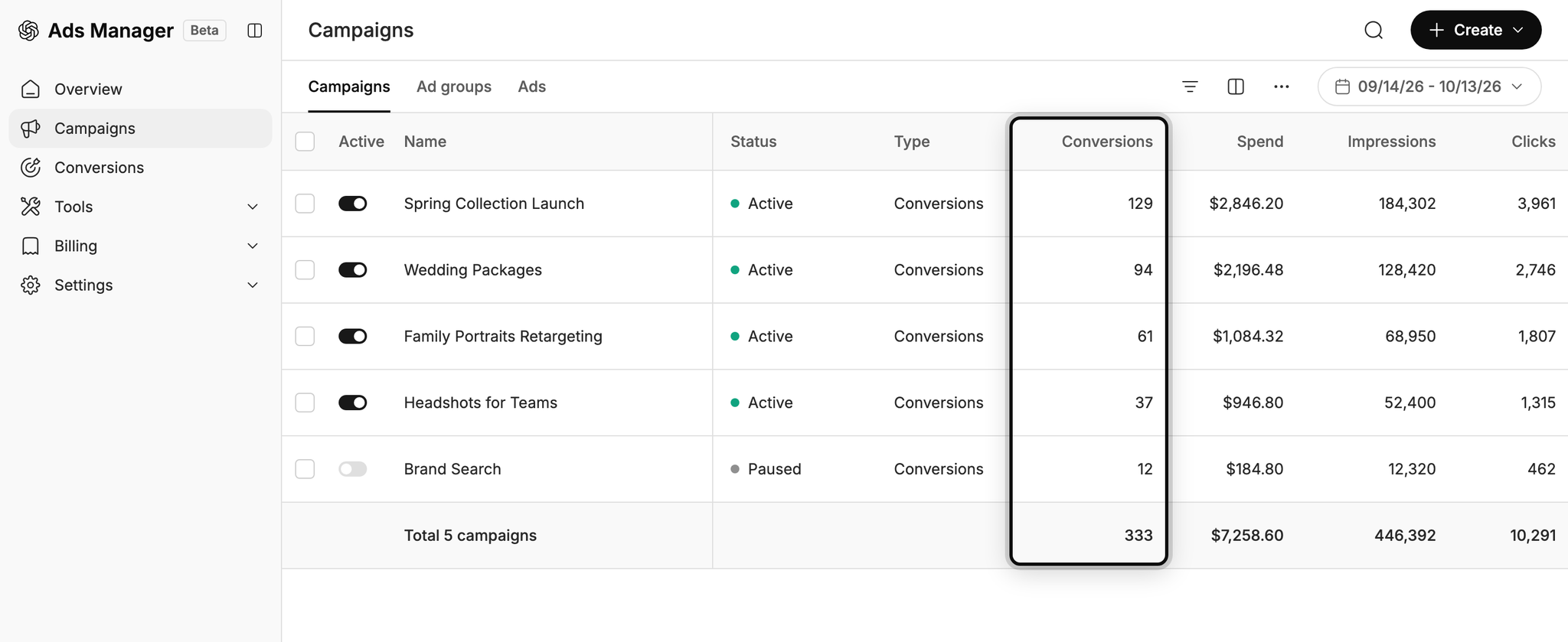
When conversion tracking isn't set up properly, ChatGPT Ads can only really report on impressions and clicks (and clicks on their own don't grow a business).
With reliable conversion data coming through, you can see exactly how many leads every campaign and ad is producing, what each lead is costing you, and where your biggest growth opportunities are.
2. Let OpenAI's algorithm find you more of the right people
ChatGPT Ads uses sophisticated AI to decide who sees your ads and which conversations they show up in.
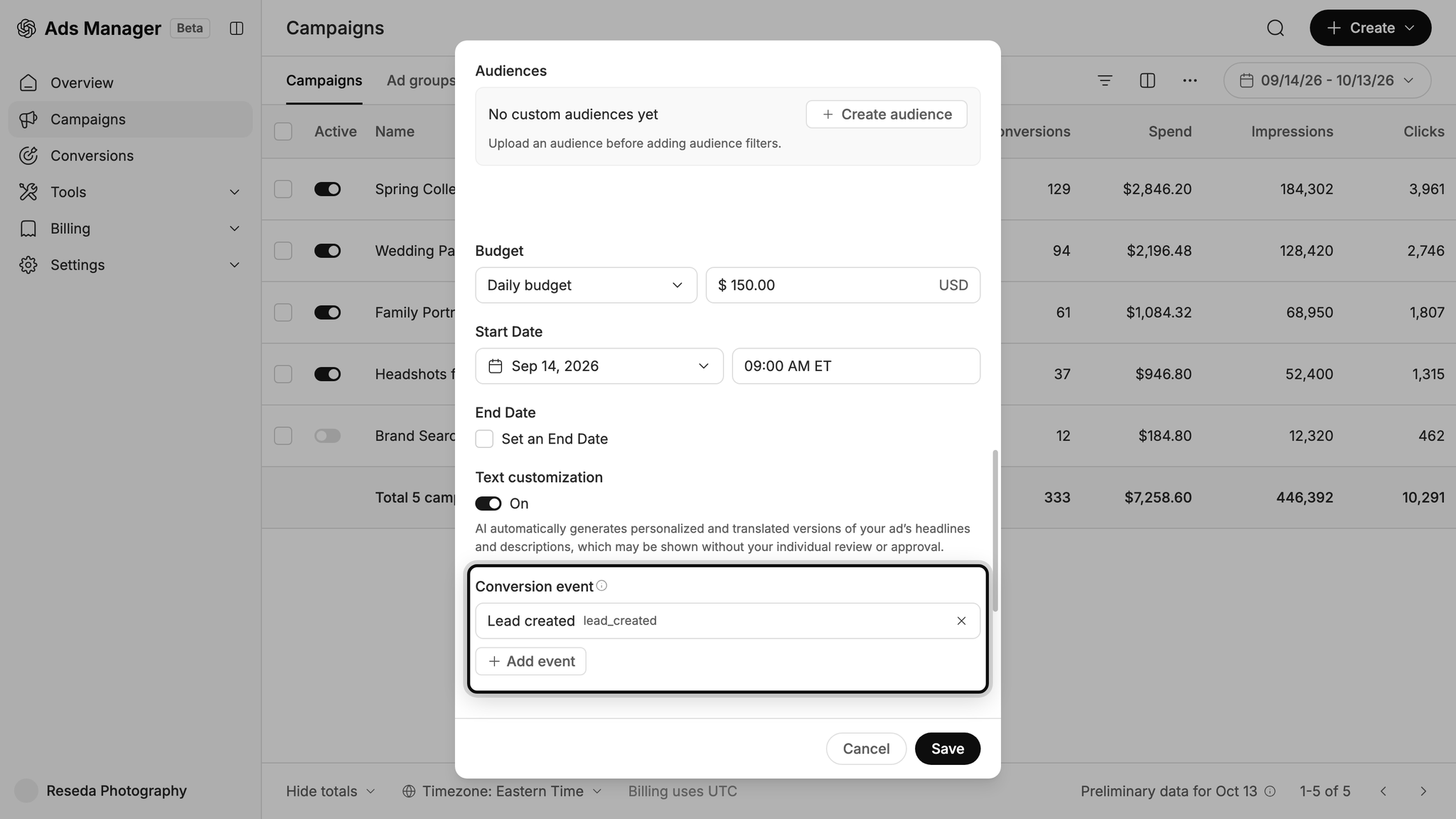
With proper conversion tracking in place, that AI has the data it needs to learn what a good lead looks like and when it's a good time to show your ad, and it will use that to serve your ads to the right people at the right time in the future.
Wrap Up
If you want to send a conversion to ChatGPT Ads every time someone submits a form on your Framer website, Converly is the easiest (and best) way to make it happen.
Because it sends conversions straight to OpenAI's servers, ad blockers and privacy-focused browsers can't get in the way. And because it includes all the identifiers OpenAI uses to match conversions back to real people (the click ID, name, email address and more), every lead has the best possible chance of being linked back to the ad that brought it in.
Best of all, it only takes a few minutes to set up and comes with a 14-day free trial (no credit card required), so start your free trial today!
About the author

Aaron is the founder of Converly. With over 15 years of experience in digital marketing and SaaS, he's passionate about helping businesses track and optimise their ad conversions.